Siblings in special needs families grow up a little faster, and they carry things they rarely say out loud.
Raising a child with special needs is a journey that reshapes a family in profound ways. It not only challenges the parents but also significantly affects the siblings. This blog explores the dynamic of sibling relationships in families with a special needs child and offers insights into how parents can nurture positive interactions within the family.
Quick answer: Sibling relationships in special needs families are deeply shaped by the extra demands on parental attention and the child’s own need to make sense of their sibling’s differences. With intentional parenting, these relationships often become a source of extraordinary empathy and lifelong loyalty.
Unique Challenges and Opportunities
Siblings of children with special needs encounter a unique set of challenges and opportunities from an early age. They often experience a wide range of emotions, from confusion and concern to love and protectiveness. It’s not uncommon for these siblings to take on more responsibilities, sometimes maturing quicker than their peers.
On one hand, these experiences can foster empathy, resilience, and a strong sense of responsibility. Siblings may develop a deep bond with their special needs brother or sister and a unique understanding of diversity and inclusion. On the other hand, they might also feel overlooked at times when the needs of their sibling take precedence.
Emotional Rollercoaster
One of the most significant impacts on siblings is the emotional complexity involved. They may feel pride in their sibling’s accomplishments but also struggle with feelings of jealousy or resentment due to the extra attention their sibling receives. Parents can help by fostering open discussions about emotions and ensuring each child’s feelings are heard.
To further support emotional resilience, resources like Learning to Listen: Effective Communication with Special Needs Children can provide parents with strategies to engage their children in meaningful conversations. This not only addresses their concerns but also strengthens sibling bonds through improved understanding. Siblings Matter is written for this sibling, the one everybody assumes is fine.
Role of Parents in Balancing Needs
Parents play a critical role in balancing the needs of all their children. This balance is not about dividing attention equally but rather about meeting the needs of each child as required. Communication is key. Parents should talk openly about their special needs child’s condition with their other children, explaining it in a way that is appropriate for their age. For the explaining part, we recommend Celebrating Differences: How to Teach Siblings about Special Needs, which gives you age-appropriate language for talking to a brother or sister about a diagnosis.
Finding ways to involve siblings in the care and daily lives of their special needs brother or sister can also enhance their relationship. Engaging activities that promote shared learning and teamwork, as discussed in Crafting Connections: Social Skills Development for Special Needs Kids, are particularly helpful in building a sense of mutual support and cooperation.
Long-term Benefits and Bonds
Despite the challenges, the long-term benefits of growing up with a sibling who has special needs are significant. Siblings often grow up to be more inclusive and compassionate adults. They are typically very protective of their special needs sibling and committed to their well-being.
Moreover, these siblings tend to develop strong problem-solving skills and an ability to handle unexpected situations with grace. These are valuable skills that benefit them in all areas of life, from personal relationships to professional environments.
Support for Siblings
Supporting siblings in families with special needs children is crucial. Many communities offer support groups and recreational programs specifically for these siblings. These programs provide them with a space to meet others in similar situations, which can be incredibly reassuring and validating.
Parents can use Circles of Support: Building Strong Networks for Special Needs Families as a guide to identifying and connecting with these resources. By cultivating a network of support, parents ensure their children have access to the help and community they need to thrive. Counseling or therapy can also be invaluable in helping siblings process their feelings, providing a space for them to express themselves freely and gain helpful strategies for managing complex emotions.
The Sibling No One Is Asking About
The neurotypical sibling in a special needs family is often described as remarkably mature, empathetic, and independent. These descriptions are usually accurate. They are also sometimes signs of a child who has learned to need very little because the family system did not have space for their needs. Research published through the Child Mind Institute on siblings of children with disabilities shows that while many siblings develop exceptional social skills and empathy, a significant subset also experience feelings of jealousy, resentment, anxiety, and loneliness that they do not feel they have permission to express.
The American Academy of Pediatrics guidance on siblings of children with special needs recommends that parents create regular one-on-one time with neurotypical siblings, give age-appropriate explanations of their sibling’s diagnosis, and actively normalize the expression of difficult feelings rather than celebrating only the positive responses. The sibling who says “I wish things were different” is not being unkind. They are being honest. Honoring that honesty is one of the most important things you can do for them.
Sibling support programs exist in many areas, including the Sibling Support Project’s national SibShop program, which creates peer support communities for siblings of people with special needs. These programs give siblings a space to be themselves, outside of their role in the family, which is something they rarely get to experience otherwise.
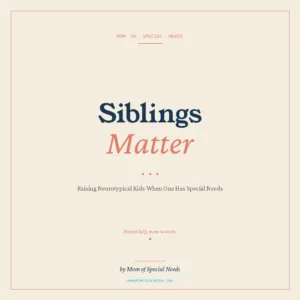
Siblings Matter: Raising Neurotypical Kids When One Child Has Special Needs
Sources and further reading
- Child Mind Institute on siblings of children with disabilities
- American Academy of Pediatrics guidance on siblings of children with special needs
Conclusion
The relationships between siblings in families with special needs are multi-faceted and influential. While these relationships come with their own set of challenges, they also offer unique opportunities for growth and development. Parents can deepen these bonds by fostering open communication, nurturing social skills, and building a network of support for the entire family.
By incorporating insights from resources like Crafting Connections, Learning to Listen, and Circles of Support, families can navigate this journey with confidence. These tools empower parents to cultivate an environment where all their children (special needs or not) thrive together, equipped with the empathy and resilience to navigate life’s complexities.
If you want more of this kind of honest, practical guidance, Celebrating Differences goes deeper into how to help siblings understand, process, and ultimately celebrate what makes their family unique.
How to Protect Your Own Sense of Fairness
Many parents in special needs families carry significant guilt about the neurotypical sibling. They worry that they have shortchanged them, that the sibling has had to grow up too fast, that the family dynamics have taken something from them that they cannot give back. This guilt is common and understandable. It is also worth examining carefully. The sibling is not a victim of their family. They are a person shaped by a unique set of circumstances, some of which are genuinely difficult and some of which are genuinely gifts. Both are true simultaneously. Hold both.
Parenting all of your children, including the one who seems to be handling everything fine, is a full-time job. The sibling who is quiet, capable, and apparently doing well still needs your time, your attention, and your curiosity about who they are becoming. Make sure some of your parenting energy goes to them simply because they matter, not only because there is a problem to solve.
Supporting siblings in special needs families
Give each child a few minutes that belong only to them. Small, regular attention matters more than grand gestures.
Frequently Asked Questions
How do I explain my child’s disability to their sibling?
Use simple, honest, age-appropriate language. “Your brother’s brain works differently. Some things are harder for him and some things are easier. Our family helps each other.” For older children, more specific information is appropriate. Books about specific disabilities written for kids can also help. Never tell a sibling that a disability is a secret or that they should not talk about it with anyone.
How do I handle sibling jealousy when one child gets more attention?
Name it first. “I know it sometimes seems like your sister gets more of my time. That is real and I understand why that is hard.” Then be proactive about protected one-on-one time, even brief. The sibling who feels seen in their frustration is less likely to act out on it. The one whose feelings are dismissed is more likely to escalate.
What do I do when siblings fight and one has special needs?
Handle it as normally as possible while accounting for each child’s capacity. A child in meltdown cannot be held to typical behavioral standards in that moment. A neurotypical sibling who hits out of frustration still needs correction. The goal is fair, not identical. Explain the difference explicitly as your children get older.
Is it normal for a sibling to feel embarrassed by their special needs brother or sister in public?
Yes. This is a developmentally normal response, especially in adolescence. Shaming a child for feeling embarrassed does not eliminate the feeling. It just adds shame to it. Validate the feeling, explore it with curiosity, and let the child’s relationship with their sibling evolve at its own pace without pressure to perform acceptance they do not yet feel.
Should siblings participate in their brother or sister’s therapy?
Sometimes, when the therapist recommends it and the sibling is willing. Occasional participation can help siblings understand their brother or sister’s challenges and learn communication strategies that reduce conflict at home. It should never feel mandatory or like the sibling’s role is to function as a therapy partner.
How do I prepare my neurotypical child for the long-term reality of having a sibling with special needs?
Through ongoing conversation, not one big talk. Let the understanding develop as your child grows. Be honest about what is known and unknown about the future. Allow them to ask hard questions and give honest answers. Model that it is possible to love someone deeply and also find that love complicated sometimes.