
Why so many autistic children struggle with movement in ways that get missed
Understanding dyspraxia DCD autism co-occurring is something every parent of an autistic child should know about. Dyspraxia, also known as Developmental Coordination Disorder or DCD, is one of the most frequently overlooked co-occurring conditions in autistic children. If your child has autism and also struggles with handwriting, tying their shoes, catching a ball, or organizing their body through space, dyspraxia may be part of the picture.
The overlap between autism and DCD is significant. Research indicates that a substantial proportion of autistic children also meet criteria for DCD, and many parents spend years searching for explanations for motor difficulties that are never connected to the broader clinical picture.
This article explains what dyspraxia actually is, how it overlaps with autism, why it gets missed, and what you can do to support your child in practical, meaningful ways.
What dyspraxia and DCD actually mean
Dyspraxia and Developmental Coordination Disorder are terms that are often used interchangeably, though DCD is the formal clinical diagnosis. DCD is a neurodevelopmental condition that affects the ability to plan, coordinate, and execute physical movements. It is not caused by muscle weakness, intellectual disability, or a known neurological condition. It is a difference in how the brain processes and plans movement.
Children with DCD often appear clumsy, uncoordinated, or physically disorganized. They may struggle with:
- Handwriting that is slow, effortful, or illegible
- Getting dressed and managing fasteners like buttons and zippers
- Catching, throwing, or kicking a ball
- Riding a bike or learning new physical skills
- Organizing their movements in sequence, such as following a multi-step physical task
- Navigating their body through space without bumping into things
- Using utensils, scissors, or other fine motor tools
The impact on daily life is significant. For a child with DCD, tasks that neurotypical children learn with minimal effort can require enormous concentration and repetition, and may still feel effortful and frustrating.
The autism and dyspraxia overlap
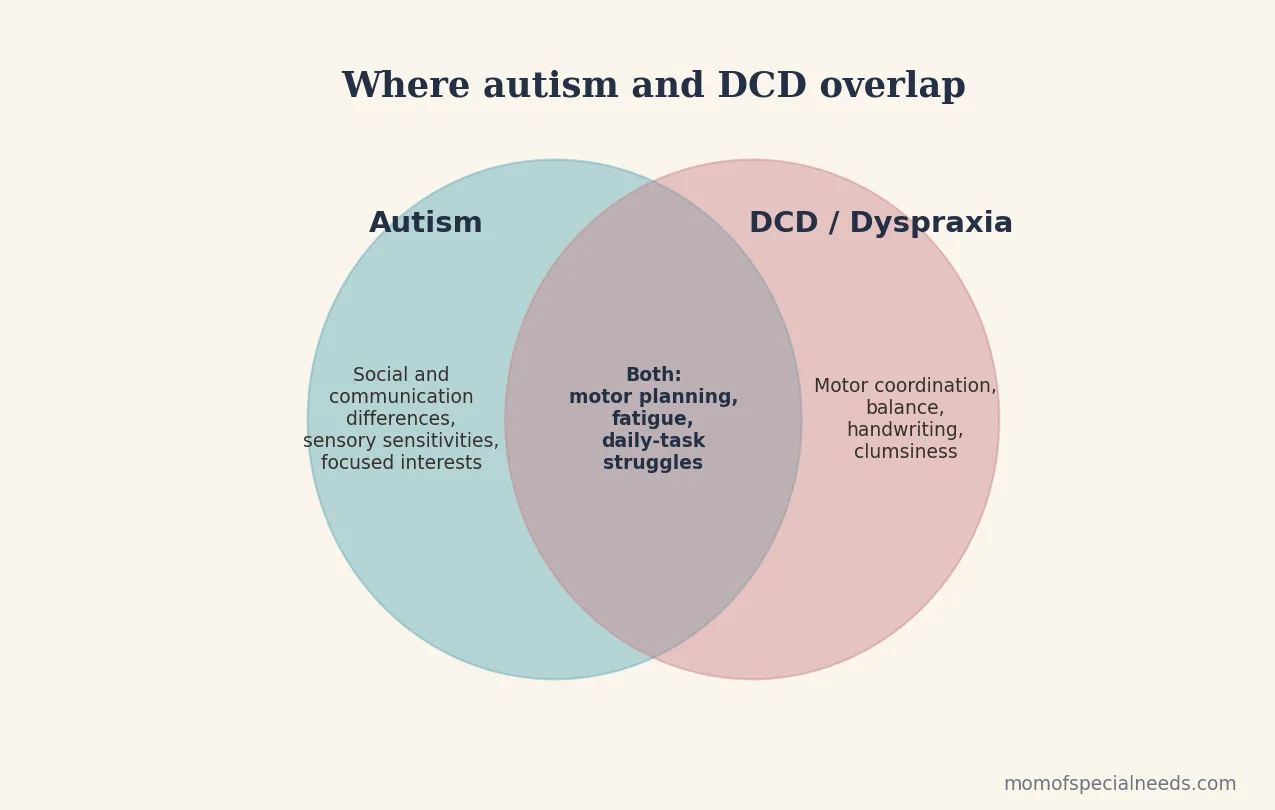
Autism and DCD share several features at the level of neurology and daily function, which is one reason they so often co-occur and also why DCD is frequently missed when a child already has an autism diagnosis.
Both conditions involve differences in motor learning and execution. Autistic people often have atypical motor patterns, including differences in gait, posture, fine motor control, and motor planning. These traits are well documented in autism research. When DCD is added on top, those motor challenges are more pronounced and require specific occupational therapy intervention.
The overlap can also mask identification. A clinician assessing an autistic child may attribute all motor difficulties to autism and not recognize the additional DCD profile. Or a family may receive an autism diagnosis and never hear the word dyspraxia mentioned at all.
Why DCD is so often missed in autistic children
There are several reasons DCD is frequently overlooked in autistic children:
First, motor difficulties are common in autism, so they can be seen as simply part of autism rather than a separate condition that warrants its own assessment and treatment. The frame of reference matters: a child who is clumsy may have their motor challenges dismissed as autism-related when they would actually benefit from targeted DCD intervention.
Second, DCD assessment requires motor-specific evaluation, including tests of motor coordination like the Movement Assessment Battery for Children (MABC-2) or the Bruininks-Oseretsky Test of Motor Proficiency. These assessments may not be included as standard in an autism evaluation.
Third, the diagnostic criteria for DCD require that the motor difficulties significantly impact daily activities and are not better explained by intellectual disability or another neurological condition. The “not better explained by” clause has historically led some clinicians to attribute motor difficulties entirely to autism, even when a child might benefit from a dual diagnosis.
Fourth, DCD is not well known among parents and many general practitioners. Without parental advocacy or a knowledgeable clinician, it can simply be missed.
What the co-occurrence means for daily life
When dyspraxia DCD autism co-occurring is present, the challenges compound in significant ways. Here is what families often describe:
School becomes harder because handwriting is laborious, taking notes by hand is exhausting, and the cognitive load of managing motor tasks leaves less bandwidth for learning content. Children who use enormous mental energy to write a sentence have less left over for thinking about what the sentence should say. Medical Maze Decoded has the referral wording for exactly this, where a second condition is hiding behind the first one.
Self-care becomes a daily battle. Getting dressed, managing personal hygiene routines, and eating with utensils may require adult support far beyond what is typical for the child’s age. This can be misread as defiance, laziness, or cognitive limitation when it is actually a genuine motor planning challenge.
Participation in physical activities becomes frustrating. Team sports, PE class, playground play, and organized activities that involve coordinated movement may be sources of anxiety and failure rather than fun. Social exclusion is a real risk when a child consistently struggles with the physical demands of child social life.
Executive function is often additionally impacted. Motor planning and executive function share neurological overlap, so children with both autism and DCD often also struggle with planning, sequencing, and organizing tasks, creating a compounding pattern of difficulty.
Occupational therapy is the cornerstone of support
The evidence-based treatment for DCD is occupational therapy with a specific focus on motor skill development. The most well-supported approaches include task-oriented intervention, which focuses on practicing specific functional skills directly, and the Cognitive Orientation to daily Occupational Performance (CO-OP) approach, which teaches children meta-cognitive strategies for solving motor problems.
For autistic children with DCD, occupational therapy needs to account for both conditions. An occupational therapist experienced with autism will understand the sensory processing differences, communication style, and potential demand avoidance patterns that interact with DCD, and will structure therapy accordingly.
Sensory integration therapy is also commonly used with this population, addressing the sensory processing differences that often underlie motor difficulties in autistic children. Proprioceptive activities and heavy work are especially helpful for building body awareness in autistic children with DCD.
Outside of formal therapy, regular practice of functional skills in natural environments, supported by parents who understand the motor planning challenges involved, is essential for generalization of skills.
Practical strategies for home and school
Here are concrete approaches that support children with both autism and DCD:
If your child also has sensory processing differences alongside DCD, deep pressure tools can complement the occupational therapy approach and help regulate the nervous system before motor tasks.
Reduce handwriting demands: Typing, speech-to-text, and scribe support are all legitimate accommodations for children with DCD. Fighting against handwriting without addressing the underlying motor difficulty often produces frustration without progress.
Allow extra time for self-care tasks: Children with DCD genuinely need more time to complete physical tasks. Building extra time into morning and bedtime routines reduces the fight and the shame.
Break motor sequences down: Complex tasks like getting dressed or packing a bag can be broken into small steps, practiced step by step, and supported with visual schedules or checklists. This works because DCD affects motor planning and sequencing, not motivation.
Avoid forced participation in physical activities: Forcing a child with DCD into physical activities where they feel incompetent increases anxiety and avoidance. Finding motor activities where the child can experience success, even if modified, builds confidence and willingness to try.
Educate teachers and school staff: DCD is not visible in the way physical disabilities are. Teachers need to understand that a child who struggles with physical tasks in the classroom is not being lazy or defiant. An IEP or 504 plan with specific motor accommodations can make a significant difference.
Communicate with your occupational therapist: The OT working with your child can provide home programs, school recommendations, and strategies customized to your child’s specific motor profile. Regular communication between home, school, and therapy makes all three more effective.
What to ask for if you suspect DCD
If you are heading into an evaluation, here is what the main tools actually check, so the words on the report make sense.
| Tool | Type | What it measures | Who completes it |
|---|---|---|---|
| Movement ABC-2 (MABC-2) | Standardized performance test, ages 3 to 16 | Manual dexterity, aiming and catching, balance | An OT or trained clinician, about 20 minutes |
| BOT-2 (Bruininks-Oseretsky Test of Motor Proficiency) | Standardized performance test | Fine and gross motor skills, strength and agility, across a wider range of ability | An OT or trained clinician |
| DCDQ-R (Developmental Coordination Disorder Questionnaire, Revised) | 15-item screening questionnaire | Control during movement, fine motor and handwriting, general coordination | Parent or caregiver, a first screen, cannot diagnose on its own |
| DCDDaily-Q | Parent questionnaire | How motor difficulties affect daily tasks like dressing and self-care | Parent or caregiver |
The MABC-2 is often treated as the reference test. A questionnaire like the DCDQ-R is a quick screen, not a diagnosis by itself.
If you suspect your autistic child also has DCD, here are specific steps:
Ask your pediatrician for a referral to a pediatric occupational therapist for a motor assessment. Specifically mention that you want to assess for Developmental Coordination Disorder and request that standardized motor assessments be administered.
If your child is in school, request an occupational therapy evaluation through the school. Schools are obligated to evaluate for conditions that may impact educational performance, and DCD qualifies.
Document what you observe at home. Specific descriptions of what your child struggles with physically, how long tasks take, and what they avoid are more useful than general statements. Write down what you see before the evaluation so you do not forget in the moment.
Push for a dual diagnosis if the evidence supports it. A child who has autism and also meets DCD criteria is entitled to both diagnoses and both kinds of support.
Medical Maze Decoded: Beat the Healthcare System for Your Special Needs Child
Frequently Asked Questions
What is the difference between dyspraxia and DCD?
Dyspraxia and DCD (Developmental Coordination Disorder) refer to the same condition. DCD is the formal clinical diagnosis used in the DSM-5 and ICD-11. Dyspraxia is an older, more informal term that is still commonly used, particularly in the UK. Both refer to a neurodevelopmental condition that affects motor planning, coordination, and the learning of physical skills.
How common is DCD in autistic children?
Research consistently shows that DCD is far more common in autistic children than in the general population. While estimates vary across studies, a significant proportion of autistic children meet criteria for DCD, making it one of the more prevalent co-occurring conditions in this population. Many experts recommend routine motor assessment as part of autism evaluation.
Can occupational therapy help a child with both autism and DCD?
Yes. Occupational therapy is the primary evidence-based intervention for DCD, and therapists with expertise in both autism and DCD can deliver effective, adapted intervention. The CO-OP approach and task-oriented intervention have specific evidence behind them for DCD, and skilled OTs will adapt their approach to the sensory and communication profile of autistic children.
Will my child grow out of DCD?
DCD does not simply disappear with age, though the specific challenges may shift as the child grows and some skills are mastered. Adults with DCD continue to experience motor planning and coordination difficulties. However, occupational therapy, targeted skill practice, and appropriate accommodations can significantly improve function and quality of life across the lifespan.
How do I explain dyspraxia to my autistic child?
The explanation depends on your child’s age and communication level. Many children benefit from a simple, strengths-based framing: their brain is wired in a way that makes learning physical skills take more effort, and that is not their fault. Connecting the explanation to experiences they have already had, using concrete examples, and reassuring them that it does not mean they are less capable can all help. An occupational therapist or psychologist with autism expertise can help you develop age-appropriate language.