
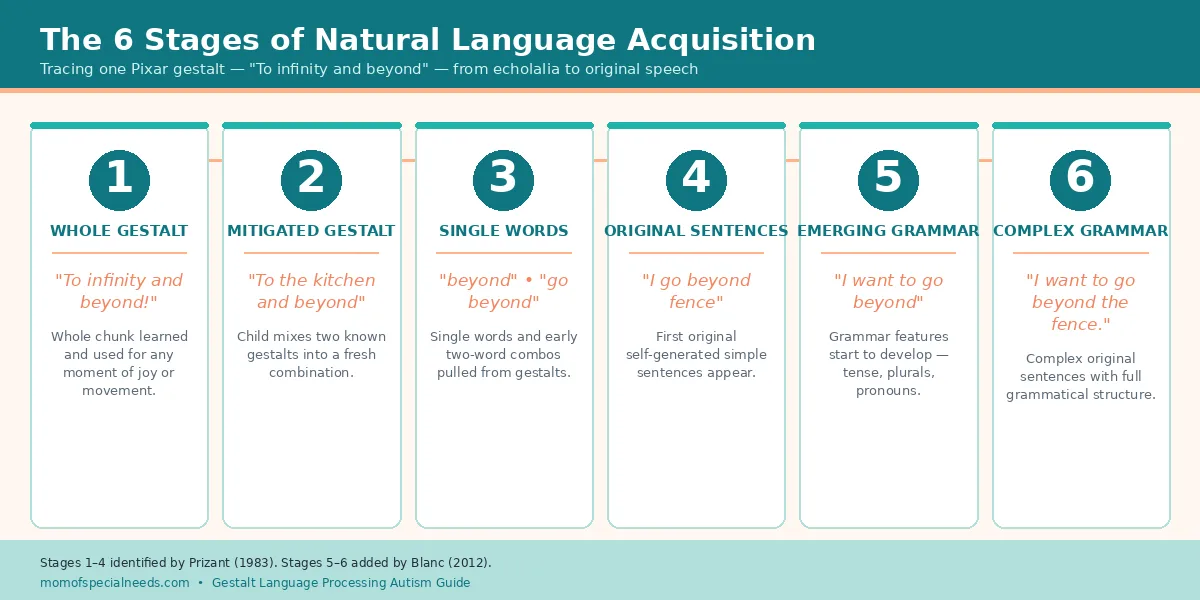
Figure 1. How a single Pixar quote can travel through every NLA stage, from echolalia to original self-generated speech.
What is gestalt language processing autism?
In his foundational 1983 paper on autistic language, Prizant argued that what looked like meaningless echolalia was actually purposeful communication. A 1984 paper by Prizant and Rydell documented 14 functional uses of delayed echolalia. Blanc, a clinical SLP, spent 15 years gathering language samples and laid out six stages in her 2012 book on autism and language. Not every researcher’s on board with the full NLA model. A 2024 paper by Venker and Lorang in Autism raised concerns about parts of the framework while still affirming that echolalia is communicative and shouldn’t be extinguished. The core idea is widely accepted. The clinical protocol around it is still being studied.
What are the 6 stages of Natural Language Acquisition?
– A Stage 1 child might shout “To infinity and beyond” for any moment of joy or movement.
– A Stage 2 kid mixes two known gestalts into something new, like “to the kitchen and beyond.”
– Stage 3 brings out single words pulled from those gestalts, plus early two-word combos.
– Stages 4 through 6 follow the typical grammar development Lee documented in 1966 and 1971.
What matters is the path. A child doesn’t have to start with single words to land at full sentences. A movie-line phase can lead straight into self-generated speech if it’s supported instead of corrected away.
How can I tell if my child is a gestalt language processor?
SLPs sometimes call GLPs “intonation babies” because they pick up tune before words. A child might sing the alphabet song or whole verses of a favorite Disney song before producing single-word requests. Some kids use one phrase like “Do you want it?” every time they want something, because that’s what adults say to them. Others appear to have clear single-word vocabulary that never combines into novel phrases. SLPs call these “stuck single-word gestalts.” If you are trying to work out what your child is telling you before any of this has a name, Learning to Listen is the guide for reading behaviour, tune and script as real communication. Long-standing research from Rutter and colleagues found echolalia in roughly 85 percent of autistic children who develop speech. If you’re seeing any of these patterns, the next move is a language sample with an NLA-trained SLP.
Why is correcting echolalia the wrong approach for a gestalt processor?
Gestalt-friendly modeling looks different. Instead of correcting “do you want it” into “I want a cookie,” an NLA-trained SLP models a new phrase the child can use in that situation, with the same rich intonation. That way the next gestalt absorbed is one that’s ready to be mitigated later. Sensory regulation matters too. A dysregulated nervous system makes language harder to access, so co-regulation often comes before words. For nonspeaking kids who use AAC, gestalt-aware programming means loading whole phrases the child cares about, not just single-word tiles. To find the right therapist, look for gestalt language processing autism specialists, SLPs trained through Marge Blanc’s Communication Development Center or certified through Alexandria Zachos’s Meaningful Speech program. Ask whether they take a language sample first, model gestalts rather than drill words, and follow your child’s lead.
Learning to Listen: Effective Communication with Special Needs Children
Sources and further reading
- 1983 paper on autistic language
- 1984 paper by Prizant and Rydell
- 2024 paper by Venker and Lorang in Autism
- Marge Blanc’s Communication Development Center
- Alexandria Zachos’s Meaningful Speech program
Frequently asked questions about gestalt language processing
Is gestalt language processing the same as echolalia?
No. Echolalia is the behavior of repeating phrases. Gestalt language processing autism is the underlying cognitive linguistic style that explains why some children acquire language in chunks rather than word by word. Echolalia is one observable feature of GLP, but the framework covers the full developmental arc from scripts to original speech.
At what age does a gestalt language processor start using original speech?
There is no fixed age. Some children move from Stage 1 to Stage 4 (original simple sentences) within a year of NLA-informed support. Others take longer. Progression depends on language exposure, sensory regulation, presence of AAC, and the quality of gestalt modeling from caregivers and therapists.
Can a nonspeaking child be a gestalt language processor?
Yes. Nonspeaking and minimally speaking children can still be gestalt processors. They may use AAC devices, sign language, or written language in gestalt patterns. NLA-aware AAC programming loads full phrases the child wants to say, not just isolated word tiles, to mirror the gestalt path.
What is a language sample in NLA assessment?
A language sample is a recorded transcript of the child’s spontaneous utterances across multiple contexts. An NLA-trained SLP analyzes the sample to identify which stage the child is in, what gestalts they are using, and which gestalts can be mitigated next. This is the starting point before any therapy goals are set.
If you’re walking this with a child who scripts
The hardest part isn’t the scripting. The hardest part is the bathroom-floor moments when you wonder if your child will ever say “I love you” without quoting a movie. Boundless Love is a $29.99 eBook for moms in exactly this gestalt language processing autism stage. No drilling. No quick fixes. Just the gestalt language processing autism framework, the regulation tools, and the honest moments from another mom who has been there.