Last updated: May 2026
My son was 6 the first time I bought a weighted blanket. It was 9 pounds. He weighed 52. The math was right. The blanket was beautiful. He hated it within 10 minutes and refused to touch it for 2 years.
I almost wrote them off forever. I was wrong to.
I tried again 2 years later with a different style. He slept through the night for the first time in 4 months. He has used a weighted blanket every night since.
Here is what I know now that I did not know then. About weighted blankets for autistic kids. About weighted blankets for autistic adults. About when they help. And about when they are a 60-dollar mistake sitting in the closet.
Do weighted blankets actually work for autism?
Weighted blankets work for many autistic kids and adults by providing deep pressure stimulation that calms the nervous system. Research shows benefits for sleep onset, anxiety, and self-regulation, with the strongest evidence for adults and older children. Not every autistic person responds to weighted blankets. About 1 in 3 reject them.
The landmark 2014 randomized controlled trial published in Pediatrics found no significant difference in total sleep time, but the autistic children and their parents preferred the weighted blanket (Gringras P, et al. Pediatrics. 2014;134(2):298-306). Later studies have been more positive. A 2020 randomized controlled trial in the Journal of Clinical Sleep Medicine found that adults with insomnia and a psychiatric condition who used a weighted blanket for four weeks were almost 26 times more likely to see their insomnia severity drop by half or more than those using a light blanket (Ekholm B, Spulber S, Adler M. J Clin Sleep Med. 2020;16(9):1567-1577). Note that this study was conducted on adults with a psychiatric diagnosis, not on autistic children or general adults without a diagnosis.
So they work for many. Not for all. The point is to try the right one the right way.
How weighted blankets help autistic kids
The weight provides deep pressure input that activates the parasympathetic nervous system. That is the “rest and digest” part of the autonomic nervous system. The same system that gets overwhelmed during a meltdown.
For autistic kids specifically, the most common reported benefits are.
- Faster sleep onset (15 to 30 minutes faster on average)
- Fewer middle-of-night wake-ups
- Calmer transitions in and out of sleep
- Reduced bedtime resistance
- Sometimes reduced morning meltdowns (downstream effect of better sleep)
The benefit is real but it is not magic. A weighted blanket does not fix all sleep problems. It is one tool in the regulation kit, not the whole kit.
The right weight for an autistic child
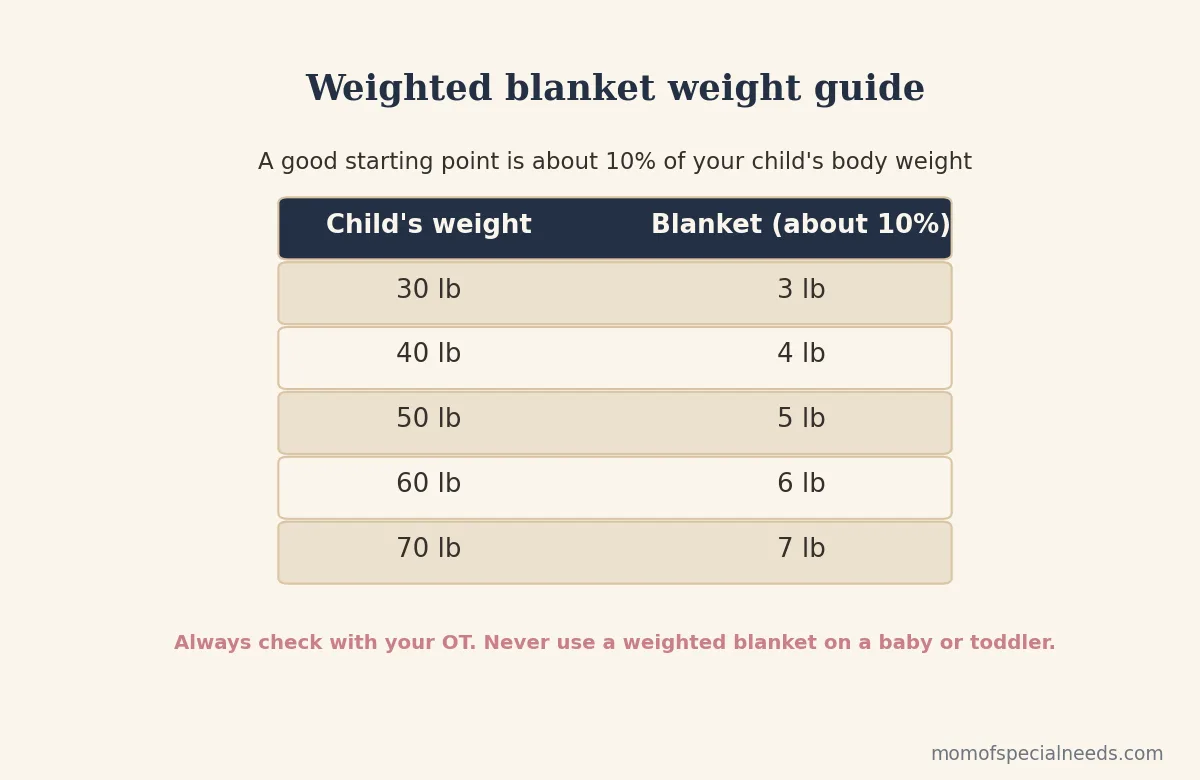
The rule is 10 percent of body weight, plus or minus 2 pounds.
- A 30-pound child: 3 pound blanket
- A 50-pound child: 5 pound blanket
- A 70-pound child: 7 pound blanket
- A 100-pound child: 10 pound blanket
Do not exceed 10 percent. The pediatric weighted blanket safety guidance from the American Occupational Therapy Association is clear. Heavier is not better for kids. Heavier is dangerous.
Do not use weighted blankets at all for children under 2. Suffocation risk.
For children ages 2 to 4, only with OT prescription and only during supervised use.
Weighted blankets for autistic adults
The same rule applies. 10 percent of body weight. Cap at 25 pounds total for any adult.
- 120-pound adult: 12 pound blanket
- 180-pound adult: 18 pound blanket
- 250-pound adult: 25 pound blanket (do not exceed this even if 10 percent would be heavier)
Why the 25 pound cap. Three reasons. Heat retention gets bad. The blanket becomes hard to reposition during sleep, which interrupts sleep more than the weight helps. Joint pressure on the chest can interfere with breathing for adults with sleep apnea, anxiety disorders, or compromised respiratory function.
For autistic adults specifically, here is what to look for.
- Cotton outer cover (not polyester, polyester traps heat)
- Glass bead fill (not plastic pellet, glass beads are quieter)
- Removable washable duvet-style outer cover
- Minimum 50 by 70 inches for a single adult, 60 by 80 for a couple
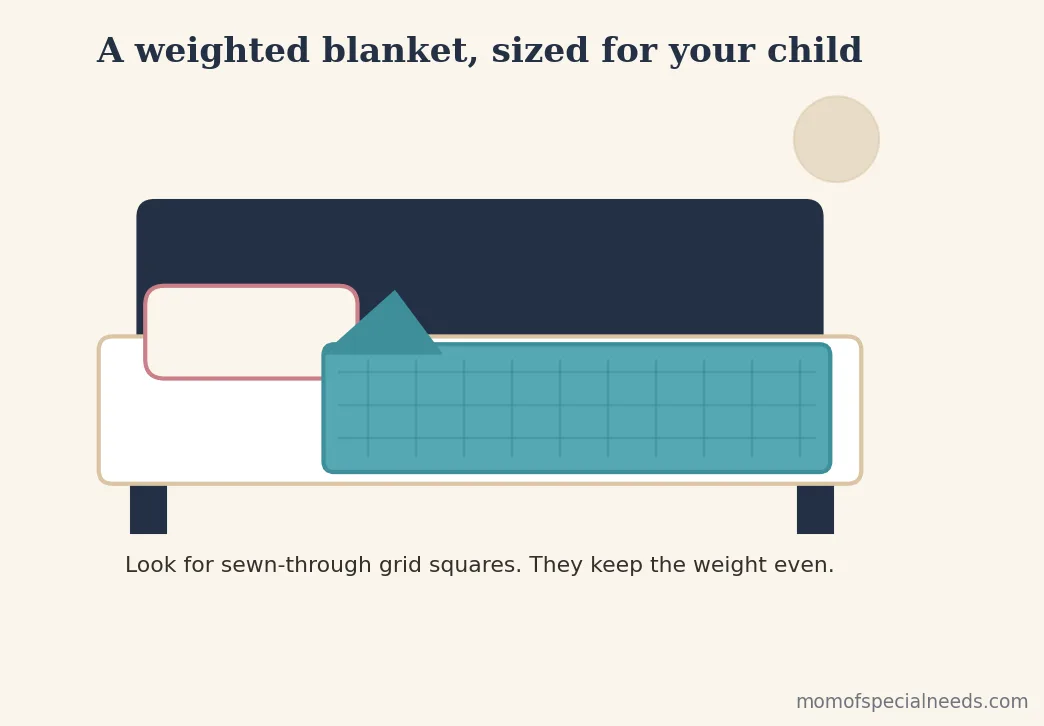
- Sewn-through grid construction (smaller squares, prevents bead migration)
Weighted blanket comparison: 4 options at 4 price points
| Price Tier | Best For | Key Feature | Drawback |
|---|---|---|---|
| Under 40 dollars | First try, kid | Quick to test | Plastic pellets, noisy |
| 40 to 80 dollars | Daily use, kid | Glass beads, cotton cover | Single fabric, not as breathable |
| 80 to 150 dollars | Daily use, adult | Bamboo or cooling cover | Premium price |
| 150 plus dollars | Adult with sensory sensitivity | Cooling, removable duvet, custom weight | Expensive if it does not work |
For specific brand recommendations and current pricing, see the regularly updated picks via the deep pressure tools OT-ranked guide.
How to use a weighted blanket the right way
This is where most parents go wrong.
The blanket is for sleep and for short therapy-style use. It is not for all-day use.
- For sleep: cover the body from chest to feet. Not over the face. Not over the head.
- For daytime calming: 15 to 20 minute sessions. Not all day.
- For car rides: a lap pad version (2 to 5 pounds), not the full blanket.
- For school: a lap pad on the desk, with teacher and OT approval.
Stop use immediately if the child or adult reports overheating, anxiety, claustrophobia, or trouble breathing. Some autistic people experience the weight as overwhelming rather than calming. That is a real response, not a behavior. If the weight is not landing, the room is usually the bigger lever, and Creating Calm walks through the lighting, sound and layout changes that do more for regulation than any single tool.
When weighted blankets do NOT help
Be honest about this. A weighted blanket is not the right tool when.
- Your child is sensory avoidant for pressure (gentle pressure is fine, deep is not)
- Your child overheats easily (try a cooling weighted blanket or skip)
- Your child has uncontrolled epilepsy (consult neurologist first)
- Your child has respiratory issues
- The child rejects the blanket after 3 supervised attempts
If the blanket does not help after 2 weeks of consistent use, it does not help. Return it or donate it. Try a different tool. A sensory swing calms some kids that weighted blankets cannot reach. A proprioceptive activity routine works better than a blanket for some sensory-seeking kids.
Creating Calm: Designing a Soothing Home Environment for Special Needs
Where to buy weighted blankets for autism in 2026
Specialty sensory brands tend to be best for autism-specific features (washable covers, glass beads, custom sizing). Mainstream retailers are fine for the first try at a low price point.
- Harkla (autism-focused, customizable)
- Sensory Owl (UK and US, premium)
- Bearaby (cooling, knit weighted blanket, adult focused)
- Target and Walmart (budget options for first try)
- Amazon (huge selection, mixed quality, read reviews carefully)
Frequently asked questions
Do weighted blankets help autistic kids sleep?
Weighted blankets help many autistic kids fall asleep faster and stay asleep longer by providing deep pressure stimulation that calms the nervous system. Research shows mixed results in total sleep time but consistent subjective improvement in sleep quality for both kids and parents.
How heavy should a weighted blanket be for an autistic 5-year-old?
Use the 10 percent of body weight rule. For a typical 40-pound 5-year-old, a 4 pound weighted blanket is appropriate. Do not exceed 10 percent for any child. The American Occupational Therapy Association recommends avoiding weighted blankets entirely for children under 2.
Are weighted blankets safe for autistic toddlers under 3?
No. Weighted blankets pose a suffocation risk for children under 2 and should be avoided. For children 2 to 4, only use with OT prescription and supervised application during awake hours, not for unsupervised overnight use.
Can an autistic adult use a weighted blanket every night?
Yes. Most autistic adults can use a weighted blanket every night with no adverse effects when the weight is within safe range (10 percent of body weight, cap at 25 pounds). Stop use if you experience overheating, anxiety, claustrophobia, or breathing difficulty.
How long should a weighted blanket be used during the day?
For daytime regulation use, limit sessions to 15 to 20 minutes. The blanket should be a regulation tool used intentionally, not all-day passive coverage. All-day use can desensitize the nervous system and reduce the blanket’s effectiveness for sleep.
What weight is best for a 100-pound autistic teenager?
A 10 pound blanket is appropriate for a 100-pound autistic teenager using the 10 percent of body weight rule. If the teen is sensory seeking and tolerates more, you can go up to 12 pounds, but never exceed 12 pounds for a 100-pound body.
Are weighted blankets a fire hazard?
Most modern weighted blankets are made of fire-resistant materials but check the label. Glass beads are non-combustible. Plastic pellets can melt at high temperatures. Avoid using a weighted blanket near open flames, space heaters, or as bedding for someone who smokes.
Can a weighted blanket make sensory overload worse?
Yes for sensory avoidant individuals. Deep pressure stimulation is helpful for sensory seekers but can be overwhelming for sensory avoiders. If a weighted blanket increases anxiety, agitation, or shutdown behavior, discontinue use and try lighter pressure tools like a compression vest or weighted lap pad.
One last thing
The blanket is a tool. Not a fix. If you are using a weighted blanket and your kid is still melting down at bedtime, the blanket is not the whole answer. The free 60-Second Meltdown Reset covers what to do in the moment when the blanket is on but the regulation is not working yet. Use them together.
Do weighted blankets help autistic kids sleep?
Weighted blankets help many autistic kids fall asleep faster and stay asleep longer by providing deep pressure stimulation that calms the nervous system. Research shows mixed results in total sleep time but consistent subjective improvement in sleep quality for both kids and parents.
How heavy should a weighted blanket be for an autistic 5-year-old?
Use the 10 percent of body weight rule. For a typical 40-pound 5-year-old, a 4 pound weighted blanket is appropriate. Do not exceed 10 percent for any child. The American Occupational Therapy Association recommends avoiding weighted blankets entirely for children under 2.
Are weighted blankets safe for autistic toddlers under 3?
No. Weighted blankets pose a suffocation risk for children under 2 and should be avoided. For children 2 to 4, only use with OT prescription and supervised application during awake hours, not for unsupervised overnight use.
Can an autistic adult use a weighted blanket every night?
Yes. Most autistic adults can use a weighted blanket every night with no adverse effects when the weight is within safe range (10 percent of body weight, cap at 25 pounds). Stop use if you experience overheating, anxiety, claustrophobia, or breathing difficulty.
How long should a weighted blanket be used during the day?
For daytime regulation use, limit sessions to 15 to 20 minutes. The blanket should be a regulation tool used intentionally, not all-day passive coverage. All-day use can desensitize the nervous system and reduce the blanket’s effectiveness for sleep.
What weight is best for a 100-pound autistic teenager?
A 10 pound blanket is appropriate for a 100-pound autistic teenager using the 10 percent of body weight rule. If the teen is sensory seeking and tolerates more, you can go up to 12 pounds, but never exceed 12 pounds for a 100-pound body.
Are weighted blankets a fire hazard?
Most modern weighted blankets are made of fire-resistant materials but check the label. Glass beads are non-combustible. Plastic pellets can melt at high temperatures. Avoid using a weighted blanket near open flames, space heaters, or as bedding for someone who smokes.
Can a weighted blanket make sensory overload worse?
Yes for sensory avoidant individuals. Deep pressure stimulation is helpful for sensory seekers but can be overwhelming for sensory avoiders. If a weighted blanket increases anxiety, agitation, or shutdown behavior, discontinue use and try lighter pressure tools like a compression vest or weighted lap pad.
Weighted blankets are one option among many. Compare them with the rest in our sensory tools for autism guide.