
Autism school transitions are not just back-to-school nerves. They are a full nervous system reset for an autistic child, often triggering meltdowns, regression, sleep disruption, and refusal for 2 to 6 weeks. To survive, start preparation 4 to 6 weeks before day one, build a one-page profile for the new teacher, visit the school multiple times, and protect the after-school window like a sacred space. The transition gets easier. Just not this week.
Quick stats first
- About 1 in 31 children in the US is identified with autism spectrum disorder (Source: CDC, 2025, based on 2022 data).
- Roughly 40 to 50 percent of autistic children experience clinically significant anxiety, with school transitions being one of the most reported triggers (Source: autism anxiety prevalence research).
- Special education services in the US are provided under IDEA, which requires schools to evaluate and accommodate children with disabilities within set timelines (Source: Individuals with Disabilities Education Act, ongoing federal law).
Why are school transitions so hard for autistic children?
Transitions are hard because autistic brains rely on predictability for regulation, and a new school year demolishes every predictable variable at once: the building, the smells, the schedule, the teacher’s voice, the bathroom location, the kids around them, the bus route, and even what hangs on the walls. To you it is a new classroom. To them it is a new planet.
I learned this the hard way the year my son moved from kindergarten to first grade. Same school. Same hallway. Different room. Same bus driver. Different seat. Day one he walked in fine. Day two we found him hiding in a coat closet at 9:14 AM with both shoes off. The school called it behavior. It was not behavior. It was the third day of a nervous system unable to find a single familiar anchor.
The brain’s threat-detection system stays on high alert until enough predictability returns. That is why autism school transitions often produce regression: kids who were toilet-trained start having accidents, kids who slept through the night start waking, kids who were verbal go quieter. None of this means progress is lost. It means the system is overloaded. School IEP Wars has the transition letter template, so the new team gets the same information the old one had.
If you have not yet, this is the moment to revisit how to spot the early signals in sensory overload signs.
When should I start preparing for the new school year?
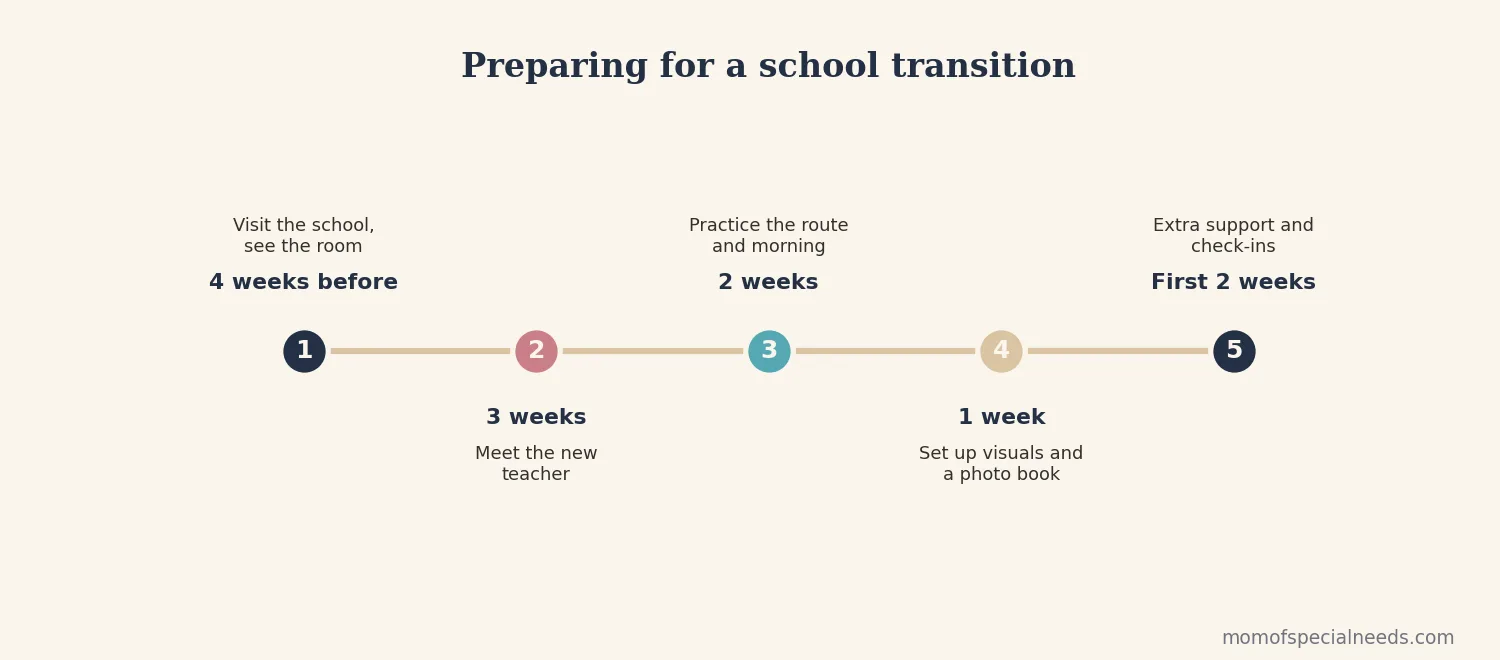
You start 4 to 6 weeks before day one, not the night before. Earlier prep does not make it worse. Lack of prep makes it worse.
Your 6-week prep timeline:
- 6 weeks out. Get the teacher assignment if possible. Email the principal if necessary.
- 5 weeks out. Build the one-page student profile (see below).
- 4 weeks out. Schedule a school visit. Ask to walk the route from the front door to the classroom, the cafeteria, and the bathroom your child will use.
- 3 weeks out. Take photos at the school visit. Build a photo book or video your child can rewatch.
- 2 weeks out. Slowly shift sleep and morning schedule to match the school day.
- 1 week out. Drive the route. Pack the backpack together. Lay out clothes. Do a full dry run including the morning timing.
- The day before. Light schedule. No big outings. Protect the nervous system.
You can read more about how to advocate at the IEP table during transition planning in this guide to IEP meeting preparation.
What should I tell the new teacher about my autistic child?
Copy this, fill it in, and hand it to the new teacher in the first week. It saves everyone weeks of guessing.
| What to share | Notes for my child |
|---|---|
| Triggers | (what tips them into distress) |
| Calming strategies that work | (what actually helps them settle) |
| Communication style | (how they best understand you and show you what they need) |
| Sensory needs | (sounds, lights, textures, space, smells) |
| Strengths and interests | (what motivates and engages them) |
| Early signs of overwhelm | (what to watch for before a meltdown) |
Keep it to one page. A new teacher will read one page.
You tell them everything they need to know in one page. Not three. Not five. One. Teachers have 25 other students and 6 hours to know your child. Make it easy.
The one-page student profile, in this exact order:
- My name, what I like to be called, my pronouns. This sounds small. It is not.
- What I am great at. Lead with strengths. Always. Teachers respond to a child they already like.
- How I communicate. Verbal, partial, AAC, hand signals. Include what I do when I cannot find words.
- What overwhelms me. Specific. “Loud unexpected noises like fire drills” not “noise.”
- My early warning signs. What I look like 5 minutes before I melt down. Hand flapping, ear covering, going quiet, asking for water repeatedly.
- What helps me regulate. My calm-down tools, my safe person, my safe place, the sentence that always works.
- What does not help. Time-outs, lectures, raised voices, taking my fidget away, asking me to make eye contact.
- Medications and medical needs. Brief. Include emergency contact.
- Mom’s contact and best way to reach me. Phone, text, email. Best response time.
This document is gold. Hand it to the teacher in person if you can. Email it. Hand a copy to the principal, the school nurse, the bus driver, and the para. The Center for Parent Information and Resources publishes resources on advocating during these transitions. advocating during school transitions.

School IEP Wars: How to Win the Services Your Child Deserves
Sources and further reading
What do I do if my child refuses to go to school?
You stay calm in front of them and you fall apart in the car after drop-off. School refusal in autism is not defiance. It is the nervous system saying I cannot do this today. Treat it that way.
Five steps when refusal starts:
- Lower your voice and slow your body. Their nervous system is mirroring yours. If you panic, the resistance doubles.
- Validate the feeling, not the behavior. School feels too big today. I get it. I have felt that way too. Then redirect to the next small step.
- Use the smallest possible next step. Not we are going to school. Try let’s put your shoes on then let’s get in the car then let’s drive past the school.
- Have a script with the school for partial days. Many IEPs can include a graduated return after long breaks or transitions. Ask for it in writing.
- Track patterns. Is it Mondays? After PE? On fire-drill weeks? Patterns reveal the trigger.
If refusal lasts more than 2 weeks or you see new regression, contact the school’s case manager and request an IEP review meeting. The school cannot ignore a written request. The US Department of Education’s IDEA page outlines parent rights in this scenario. parent rights under IDEA.
If this is the kind of detail you wish someone had handed you the first time, Boundless Love has a whole chapter on the first 30 days of any new school year.
Frequently asked questions
How long does an autism school transition usually take?
Most autistic children take 2 to 6 weeks to fully settle into a new school year, though some take a full semester. Regression in the first 2 weeks is normal and not a sign that the placement is wrong.
Should I keep my autistic child home for the first few days?
Usually no, but a partial-day return is sometimes the right call. Long absences make the eventual return harder. Talk to the IEP team about a structured graduated return if anxiety is severe.
What is afterschool restraint collapse?
It is the term for what happens when an autistic child holds it together at school for 6 hours then melts down the moment they come home or get in the car. It is not bad behavior. It is the cost of masking and self-regulating all day with no break.
How do I get accommodations written into my child’s IEP for transitions?
Request an IEP meeting in writing before the school year starts. Bring specific requested accommodations: extended transition time between classes, a sensory break pass, a quiet space, an aide for the first 2 weeks, a visual schedule. Get them in writing.
What if the new teacher does not believe my child has autism?
This is common because masking children often look fine for the first week. Send the one-page profile, the IEP, the diagnostic documentation, and a request for a parent-teacher meeting in writing. If pushback continues, copy the principal and the special education coordinator.
Is it normal for my autistic child to regress when starting school?
Yes. Regression during transitions is common and usually temporary. Skills typically return within 4 to 8 weeks once the new routine stabilizes. If regression persists past 8 weeks or worsens, ask for a re-evaluation.
What to remember
This week feels like a forever. It is not. The first two weeks of any new school year are the worst two weeks. By week six, most of this is muscle memory for everyone involved. You will not always feel this scattered. You will not always cry in the car. The settling happens. It just takes longer than the school calendar wants it to.
If you want one honest email per week through the school year, the MoSN newsletter is where I send the unedited stuff. Subscribe to the free meltdown reset.