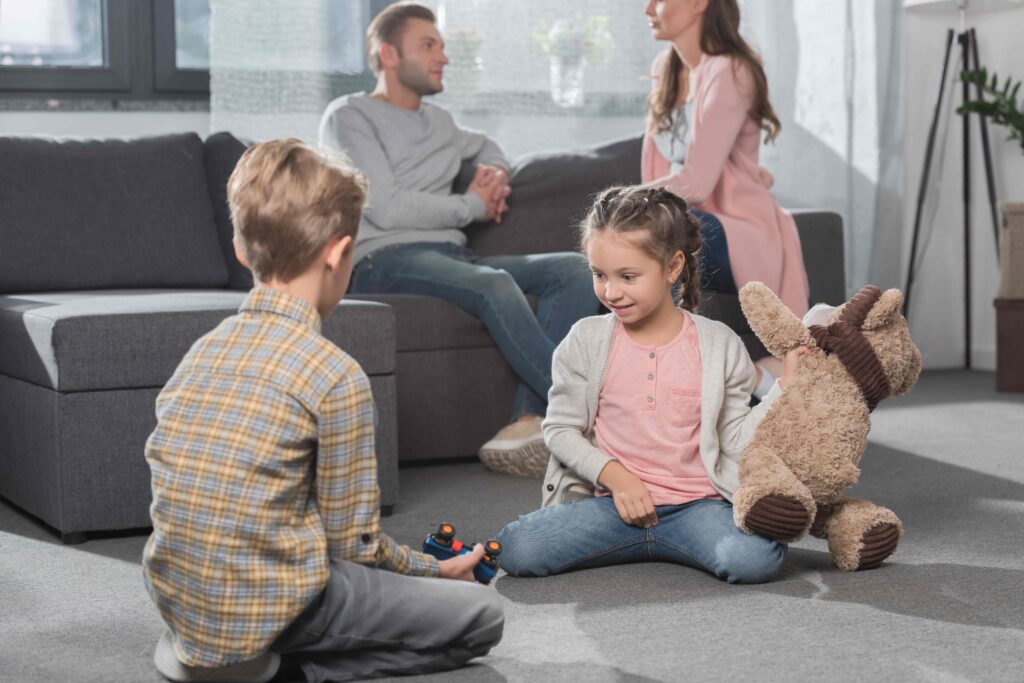
Co-regulation is the process by which a regulated adult helps a dysregulated child return to a calm state. For autistic children, this matters more than almost any other parenting skill because their nervous systems often cannot self-regulate without external support. But co-regulation has a prerequisite: it only works when the adult is regulated first.
What co-regulation actually means
Co-regulation refers to the way one person’s nervous system influences another’s. When a caregiver is calm, regulated, and present, their child’s nervous system takes cues from that. The voice is steady, the body is relaxed, the breathing is slow, and all of those signals communicate safety to the child’s brain. That communication happens faster than thought, through posture, tone, facial expression, and proximity.
When the adult is not regulated, the opposite happens. An escalating voice, a tense posture, or rapid breathing signals threat rather than safety, and the child’s already dysregulated nervous system responds by escalating further. This is not a failure of willpower on either side. It is how nervous systems work.
Why co-regulation is especially important for autistic children
Autistic children often have nervous systems that are more sensitive and less resilient than neurotypical children’s. Sensory input that seems minor can be experienced as overwhelming. Social demands that seem routine can be genuinely exhausting. Transitions that seem predictable can still produce significant anxiety. The result is a nervous system that spends much of the day working harder than it should have to, and that has less capacity to recover on its own.
Because autistic children often cannot self-regulate as effectively as neurotypical children, they remain dependent on external co-regulation longer and more consistently. This is not immaturity or manipulation. It is a feature of how their brains develop and work. Expecting an autistic child to self-regulate in a moment of overwhelm before they have the internal resources to do so is like expecting someone to lift with a muscle they have not yet developed. Boundless Love works through how a child builds emotional skills, and co-regulation is the first rung of that ladder.
When a parent understands this, the goal shifts from getting the child to calm down to becoming the calm that helps the child come back. That is a very different orientation, and it produces very different results.
What regulating yourself first looks like in practice
Regulating yourself first sounds simple but it is one of the hardest things to do consistently. When your child is screaming, throwing something, hitting, or has collapsed on the floor of the grocery store, your own nervous system activates. Your heart rate goes up. Your thoughts narrow. You may feel embarrassed, frightened, or flooded with frustration. All of that is normal, and none of it makes you regulated.
Practical strategies for regulating yourself in the moment include slowing your breathing deliberately before you speak, dropping your shoulders and unclenching your jaw, reducing the volume and pace of your voice even if it feels forced, creating a few seconds of physical space if that is possible and safe, and noticing what is happening in your body without trying to fix it immediately.
None of these require you to feel calm. They require you to act in the direction of calm while your own nervous system catches up. The acting often brings the feeling along behind it, and in the meantime your regulated behavior is communicating safety to your child regardless of what you feel internally.
The role of the parent’s nervous system in the home environment
Beyond individual meltdown moments, the parent’s ongoing nervous system state shapes the entire home environment. A home where the adult is chronically stressed, hypervigilant, or emotionally reactive creates an ambient level of alertness and threat sensitivity in the child that makes everything harder. Transitions, demands, and sensory challenges all land heavier when the underlying baseline is elevated.
This is not about performing calm or pretending life is fine when it is not. It is about recognizing that your child’s nervous system is in constant conversation with yours, and that the work you do to manage your own regulation is not separate from parenting your child. It is one of the most direct ways you care for them.
Parents who are stretched thin, not sleeping, not eating, and carrying enormous amounts of stress without support cannot co-regulate effectively. This is important to name because many parents of autistic children are doing exactly that, and the gap between what they are being asked to do and what they have the resources to do is real. Addressing your own depletion is not a luxury. It is a prerequisite for the kind of parenting your child needs.

Boundless Love: Nurturing the Emotional Growth of Special Needs Children
Sources and further reading
Co-regulation across different situations
Co-regulation looks different depending on the situation. During a meltdown, it means lowering your voice, reducing demands, offering gentle physical proximity if your child tolerates touch, and waiting with them rather than trying to talk them out of what they are feeling. The goal is not to fix the meltdown but to be a safe presence through it. Having a clear plan for meltdown moments can help you show up more steadily. The free meltdown reset resource can help you think through what your version of that plan looks like.
During transitions, co-regulation means giving advance notice in a calm and concrete way, being physically present if that helps your child, and matching your pace to theirs rather than escalating when they are slow. During IEP meetings and advocacy conversations, it means preparing yourself beforehand so that stress and fear do not make you reactive in the room. Being regulated in those conversations leads to better outcomes for your child. If you want to think through the preparation side of that, this guide to IEP meeting preparation covers the practical steps.
Building co-regulation capacity over time
Co-regulation is not just something that happens in crisis moments. It is built through thousands of ordinary interactions where the parent is present, attuned, and consistent. Every time you notice your child’s emotional state and respond to it accurately, every time you stay steady when they are not, and every time you repair after a moment where you were not your best, you are building their capacity to eventually self-regulate.
Autistic children develop self-regulation skills, but the timeline is often different from what is expected, and the pathway usually runs through extended co-regulation rather than early independence. Supporting that process rather than trying to short-circuit it leads to better outcomes over time.
Research in developmental psychology and neuroscience consistently points to the parent-child regulatory relationship as one of the most significant factors in outcomes for children with emotional and behavioral differences. Resources from the National Institute of Child Health and Human Development highlight the importance of relational and behavioral support approaches for autistic children, which co-regulation is at the heart of.
Frequently asked questions about co-regulation and autism
What is co-regulation in simple terms?
Co-regulation is when one person’s calm nervous system helps another person’s nervous system become calmer. In parenting, it means the parent’s regulated state provides an anchor that helps the child return from dysregulation. It works through body language, voice tone, pace, and physical presence rather than through words or reasoning.
Can I co-regulate my child if I am also anxious or overwhelmed?
You can move toward regulation even when you are not there yet. Acting in regulated ways, such as slowing your voice and breathing, even when you feel anxious, sends calming signals to your child’s nervous system and often helps bring your own regulation along. You do not need to be perfectly calm. You need to be moving toward calm and avoiding escalation.
When will my autistic child be able to self-regulate?
Self-regulation develops gradually and the timeline is different for every child. For autistic children, the development often takes longer than expected and remains more dependent on external support for more of childhood. This is a normal part of autistic neurodevelopment, not a sign that something is wrong or that your parenting has failed. Continued co-regulation support, not pressure toward independence before it is available, leads to stronger self-regulation over time.