
If you are a neurodivergent parent raising an autistic child, you already know that parenting advice written for neurotypical parents rarely fits your reality. The strategies miss the part where your own nervous system is also in the conversation, where your own sensory needs are colliding with your child’s, and where the emotional weight of advocacy lands differently when you are also navigating a world not built for you.
What it means to be a neurodivergent parent
Neurodivergent parents include people with autism, ADHD, dyslexia, sensory processing differences, anxiety, and other ways of experiencing the world that differ from the neurotypical norm. Many neurodivergent parents discovered or confirmed their own diagnoses after their child was identified. There is a reason for this: autism and ADHD have strong genetic components, and recognizing the traits in your child can illuminate a lifetime of your own experiences in a new light.
That discovery can feel like relief, grief, clarity, and complication all at once. Relief because so many things finally make sense. Grief because of the years spent not knowing and the accommodations you never received. Clarity because you now have a framework. Complication because the systems you are trying to navigate for your child are the same systems that failed you.
When your nervous system and your child’s are both in the room
One of the most honest conversations that does not happen enough is the one about what it is like when two neurodivergent nervous systems are in the same space. Your child’s meltdown is not just a parenting challenge. For a sensory-sensitive parent, it can be a sensory event that you also need to regulate through. Your child’s need for silence at the same moment you need movement. Their need for connection at the same moment you are at capacity. These overlaps are real and they are not a failure of either of you.
The standard advice to “stay calm and regulated so your child can co-regulate” is true but incomplete when the parent also has a dysregulated nervous system. What does co-regulation look like when you are not regulated? What do you do when your own emotional flashpoint is exactly the kind of situation your child is in the middle of? These are not rhetorical questions. They are the actual daily reality for many neurodivergent parents, and they deserve real, practical answers rather than simplified guidance written for someone else’s brain. Finding Your Path takes your own nervous system seriously instead of treating rest as a reward you have to earn.
The specific challenges of neurodivergent parents in the special needs system
Neurodivergent parents face particular challenges in the school and medical systems they navigate for their children. Many of these systems are built on implicit norms around communication, self-advocacy, and interaction that favor neurotypical presentation. A parent who is direct and concrete may be read as rude. A parent who becomes overwhelmed in an IEP meeting and cannot articulate what they need in the moment may be perceived as disengaged. A parent who needs to take notes and cannot maintain eye contact while doing both may be seen as uncooperative.
For the IEP meeting preparation process specifically, neurodivergent parents often benefit from doing more ahead of time in writing rather than relying on verbal back-and-forth in the meeting itself. Preparing your questions and priorities in advance, bringing a support person who can help track the conversation, and following up in writing afterward are strategies that work well for many neurodivergent parents and are appropriate regardless of how the school system views them.
The guilt that comes with shared traits
Neurodivergent parents often carry a particular guilt when their child’s challenges mirror their own. If your child struggles with transitions, and transitions have always been hard for you too, there can be a painful feeling of having passed something difficult on. If your child has meltdowns when overwhelmed, and you have spent your whole life managing your own version of that, there can be grief in watching them struggle with something you never fully resolved.
What helps here is reframing what shared traits actually mean. You understand your child’s experience in a way that most people around them never will. You have lived inside this nervous system. That is not a liability. That is a profound resource for raising a child who needs to be truly understood. The understanding you bring does not make the challenges easier, but it makes your presence different in ways that matter.
Taking care of your own nervous system
Parenting a child with high support needs is demanding for any parent. For a neurodivergent parent, the demands are layered in ways that are often invisible. You may be masking your own needs throughout a school day of advocacy calls. You may be absorbing the emotional weight of your child’s struggles in a way that is more embodied and harder to set down than it is for neurotypical parents. The recovery from a hard parenting day may take longer and require different things than it does for others.
This is not a failure. It is a reality that deserves to be named and accommodated rather than pushed through. If you have a meltdown or shutdown resource that works for your child, there may be a version of that strategy that you need too. The free meltdown reset framework can be a useful starting point for thinking about how to build in recovery time and sensory resets for yourself, not just your child.
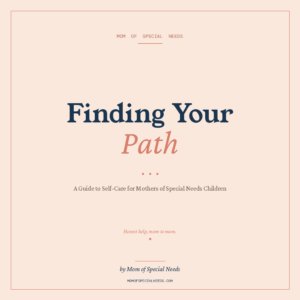
Finding Your Path: A Guide to Self-Care for Mothers of Special Needs Children
Sources and further reading
What neurodivergent parenting can look like at its best
At its best, neurodivergent parenting brings a quality of presence that is genuinely distinctive. You know what it is like to feel overwhelmed by sensory input. You know what it is like to need advance warning before transitions. You know what it is like to be misunderstood by people who assume your way of engaging is deficiency rather than difference. That knowledge is not theoretical for you. It shapes how you respond, what you notice, and what you fight for.
The research on autistic parents of autistic children points to some genuine advantages in the relationship. Autistic parents often share their child’s communication style more naturally, have less need for constant eye contact and more tolerance for parallel play and quiet coexistence, and are more likely to recognize and validate sensory needs because they experience their own. These are not minor things. These are the building blocks of a child feeling understood and safe.
Researchers and clinicians who work with neurodivergent families increasingly recognize that standard parenting models do not always translate and that neurodivergent parents often benefit from adapted frameworks. Organizations like the Centers for Disease Control and Prevention acknowledge the genetic and familial dimensions of autism, which underscores why understanding neurodivergent parents as a distinct group matters in developing family support resources.
Building a sustainable parenting life
Sustainability for neurodivergent parents means designing your life in ways that reduce friction wherever possible. This may mean establishing very clear routines that work for both your nervous system and your child’s. It may mean having explicit agreements with co-parents, partners, or family members about when you need transition time and what that looks like. It may mean being more deliberate about sensory environment than most parenting books suggest is necessary.
It also means accepting that some of the standard benchmarks of parenting success are not the right benchmarks for your family. Connection can look different. Patience can look different. A good day can look different. What matters is that your child feels safe, understood, and genuinely known by you. On that dimension, neurodivergent parents often deliver something that is hard to articulate but that their children carry with them.
Frequently asked questions about neurodivergent parenting
Can I be a good parent if I am also autistic or have ADHD?
Yes. Being autistic or having ADHD does not diminish your capacity to parent well. Neurodivergent parents bring genuine strengths to parenting, including a deep understanding of how their child experiences the world. The challenges neurodivergent parents face in parenting are real, but they are largely about navigating systems and contexts that were not designed with neurodivergent people in mind, not about any inherent limitation in your love or care for your child.
Is it common for autistic parents to have autistic children?
Yes. Autism has a significant genetic component, and autistic parents are more likely to have autistic children than neurotypical parents are. Many people discover their own autism during the process of getting their child diagnosed. This is sometimes called the identification cascade and it is common enough that clinicians who work with autistic children are increasingly screening parents as part of the family assessment process.
Where do neurodivergent parents find support?
Peer communities of other neurodivergent parents are often the most useful source of practical support because the advice comes from people with shared experience. Online communities for autistic parents and ADHD parents exist in multiple formats. Therapists who are neurodivergent-affirming and have experience with both autism and parenting support can also be a valuable resource. Adapting general parenting resources to fit your actual brain rather than following them verbatim is usually necessary and always valid.