How to Take a Family Vacation with a Child with Autism (That Everyone Actually Enjoys)
Our first family vacation after my son’s diagnosis was three days of meltdowns, one cancelled excursion, and me crying in a hotel bathtub on night two. Our last trip? He called it ‘the best day of his life.’ The difference was preparation — and knowing what we were actually dealing with.
Quick answer: A family vacation with a child with autism can be genuinely enjoyable when you prioritize your child’s specific sensory needs, prepare them thoroughly in advance, keep the pace slower than you think you need to, and choose destinations with predictable, autism-friendly environments.
Why Vacations Are Hard for Kids with Autism
Vacations break every routine. New environments, unfamiliar sounds and smells, unpredictable schedules, airport sensory overload, different food, different beds. For a child whose nervous system craves predictability, this is a perfect storm.
The goal isn’t to avoid the disruption entirely — it’s to build a structure within the chaos so your child can cope.
Before You Go: The Preparation Phase
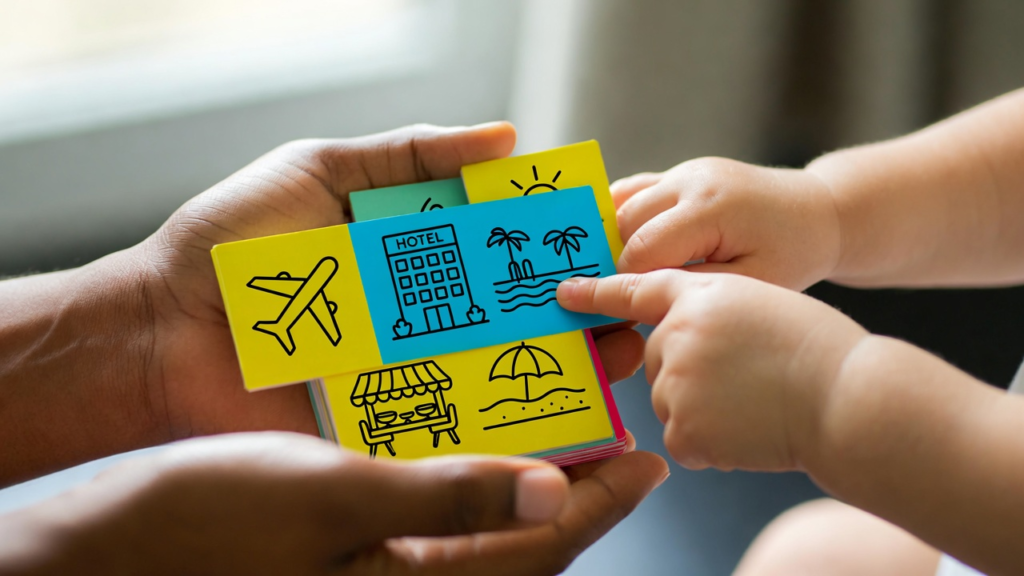
Create a Visual Schedule for the Trip
Use pictures or icons to show the sequence of events: plane, hotel, pool, restaurant. Review it daily for 1-2 weeks before travel. Predictability reduces anxiety — even for an unfamiliar event.
Watch Videos of the Destination
YouTube is your best friend. Find videos of the actual hotel room type, the airport you’ll be flying through, the theme park or beach. Familiarity before arrival significantly reduces first-day anxiety.
Pack Their Sensory Kit
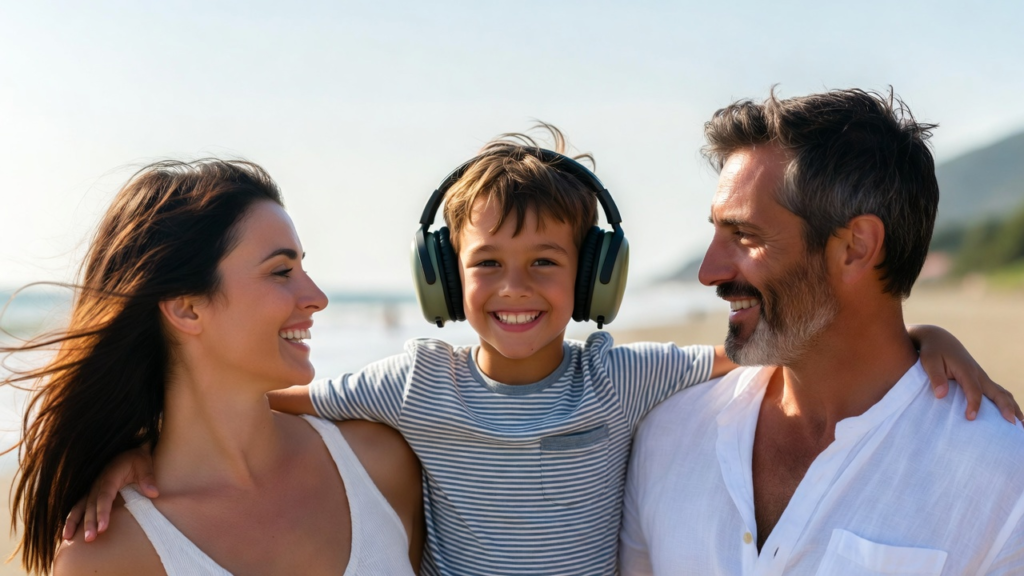
This is non-negotiable. Noise-canceling headphones, a weighted lap pad, their comfort item, preferred snacks, a fidget. The sensory kit goes in your carry-on, not checked luggage.
Choosing the Right Destination
- Look for Certified Autism Center (CAC) destinations — theme parks, resorts, and attractions with trained staff and sensory accommodations
- Consider destinations with flexibility — beaches, state parks, and nature-based trips allow for unstructured time and quiet retreats
- Avoid destinations with rigid schedules and loud, unpredictable environments for first trips
- Private rentals (VRBO, Airbnb) over hotels can be lifesavers — your own kitchen, familiar routine, no shared spaces
At the Airport: The Survival Strategy
- Arrive early — rushing is catastrophic
- Request a TSA Cares assistance pass ahead of time (call 72 hours before your flight)
- Ask airlines about pre-boarding for passengers with disabilities
- Bring familiar snacks and entertainment for every segment of the journey
- Headphones ON before entering any loud space
At Theme Parks and Attractions
Most major theme parks now offer disability access programs. At Disney, it’s the Disability Access Service (DAS). At Universal, it’s the Attraction Assistance Pass. These allow your family to return at a designated time instead of waiting in long, overwhelming queues.
Call ahead or visit guest services immediately upon arrival. Do not wait until you’re already overwhelmed to ask.
Give Yourself Permission to Do Less
You may not see everything. You may leave early. You may spend one entire afternoon at the hotel pool because your child is finally calm and happy. That counts. That is a win.
“We went to Disney for four days and only did eight rides total. My son’s favorite part was a fountain near Main Street that he stood at for 30 minutes. I almost didn’t let him stay that long. I’m so glad I did.” — A Mom in Our Community
After the Trip: The Re-Entry Plan
Coming home can be just as hard as leaving. Budget at least one full low-key day after returning before any school or therapy commitments. Let your child decompress. Let yourself decompress. Then celebrate — because you did something hard and beautiful together.
Autism-Specific Vacation Planning: What Other Travel Guides Skip
Most vacation planning guides assume a neurotypical family with neurotypical tolerance for unpredictability, noise, crowds, and schedule disruption. Vacations with an autistic child require fundamentally different planning priorities. According to research cited by the Child Mind Institute on managing anxiety during travel and events, children with autism process uncertainty as threat, which means that a vacation filled with new experiences, unfamiliar spaces, and unpredictable schedules is physiologically experienced as stressful rather than exciting, at least initially. The goal of autism vacation planning is to reduce the number of unknowns until your child’s nervous system has enough certainty to actually relax.
This means that an autism-friendly vacation often looks very different from a conventional one. Shorter duration. Fewer attractions per day. A home base that stays consistent. Predictable meal timing. Sensory kit always accessible. A clear exit strategy for any situation. Many autism families find that their best vacations are to the same destination multiple years in a row, because familiarity is itself a significant anxiety reducer. More comprehensive guidance on travel tips for special needs families covers the logistics in more depth.
The American Academy of Pediatrics travel guidance emphasizes pre-trip preparation as the highest-leverage investment for families of children with developmental differences. Walk through the trip day by day using photos, videos, and social stories before you leave. Name who will be there, where you will sleep, what meals will look like, what happens if something does not go as planned. The more familiar the unfamiliar can feel before you arrive, the more your child can actually participate in and enjoy the experience.
If you want more of this kind of honest, mom-to-mom guidance, Ready for Anything goes deeper into preparing for the unexpected challenges that come up when you take your special needs child outside of your usual routines.
Frequently Asked Questions
What destinations work best for children with autism?
Destinations with predictable environments, available quiet spaces, and disability access planning tend to work best. Many Disney parks have dedicated disability access programs, quiet rooms, and staff training. Beach destinations with open space and natural sensory input work well for children who find nature regulating. Camping at familiar campgrounds offers consistency and low stimulation. Avoid destinations that are primarily about large crowds, loud entertainment, and constant schedule variation unless your specific child handles these well.
How do I manage a long car ride or flight with a child with autism?
Build in sensory support for the journey. Headphones, familiar music or video content, fidget tools, preferred snacks, and a visual schedule of the journey itself all reduce the anxiety of extended travel. For flights, request pre-boarding and seat choice in advance. TSA Cares can be requested for airport security assistance. Break long drives with predictable stops at familiar chains rather than new restaurants.
Should I tell the hotel or venue about my child’s autism in advance?
Often yes. Many venues, theme parks, and hotels have hidden disability programs, sensory-friendly accommodations, or staff trained in autism support. The worst outcome of disclosing is that nothing changes. The best outcome is proactive support that makes your child’s experience meaningfully better. Contact venues directly before booking rather than assuming online information is comprehensive.
How do I handle meltdowns that happen in public during vacation?
Have your exit route planned before you need it. Identify the quietest areas of any venue in advance. Carry a sensory kit. Accept that sometimes you will leave early and that is the right call. Practice your own composure in advance because bystander reactions during a meltdown are predictable and your ability to ignore them protects your child’s space to regulate. You do not owe anyone an explanation while managing your child’s crisis.
How do I protect my other children’s vacation experience when one has higher needs?
Build sibling-specific activities and time into the vacation plan. If possible, split the group occasionally so your autistic child can do something at their pace while your other children do something theirs. Plan at least one activity that is specifically chosen for the neurotypical sibling’s enjoyment. Acknowledge explicitly to them that this vacation might look different from what they see at school friends’ families and that their enjoyment matters too.
What if the vacation is harder than everyday life at home?
That happens and it is okay to name it. A vacation that is harder than home is still valuable data about what your family needs. It tells you which elements were too demanding, which supports were missing, and what the next attempt should adjust. Every vacation with an autistic child, even a hard one, is knowledge that makes the next one better. Give yourself credit for trying.
Redefining What a Good Vacation Looks Like
The vacation that works for your autism family is going to look different from the vacations other families take. That is not a lesser version of vacation. It is a version calibrated to the people actually going on it. A three-day trip to a beach house your child knows, where the schedule is loose and the expectations are low, and where everyone comes home actually rested, is a more successful vacation than an action-packed itinerary that produces meltdowns every afternoon and exhaustion that requires a week to recover from.
Success looks like your child experiencing something new without falling apart. It looks like a moment at dinner when everyone is actually present and the food is okay and no one is crying. It looks like your autistic child saying or showing you that they want to come back. Those moments exist in autism family vacations. Plan for them rather than planning around them, and you are more likely to find them.
You know your child better than any vacation planner or travel guide. Trust that knowledge. Use it to design an experience that works for your family, not one that looks like everyone else’s.