
Last updated: May 2026
It is 11:42 PM. You are scrolling on the floor outside your kid’s room because you cannot leave until they fall asleep. Someone on the internet just told you self-care is a bubble bath. You want to throw your phone across the room.
You are not alone in that.
The self-care industry was not designed for special needs moms. The 60-minute morning routines. The retreats. The journaling sets. The “fill your cup” energy. None of it accounts for the reality that you cannot fill your cup when the cup never gets to sit still long enough.
So here is the real thing. 12 self-care actions that take under 5 minutes each. They work because they fit inside your actual life. They do not require a babysitter, a budget, or a personality transplant.
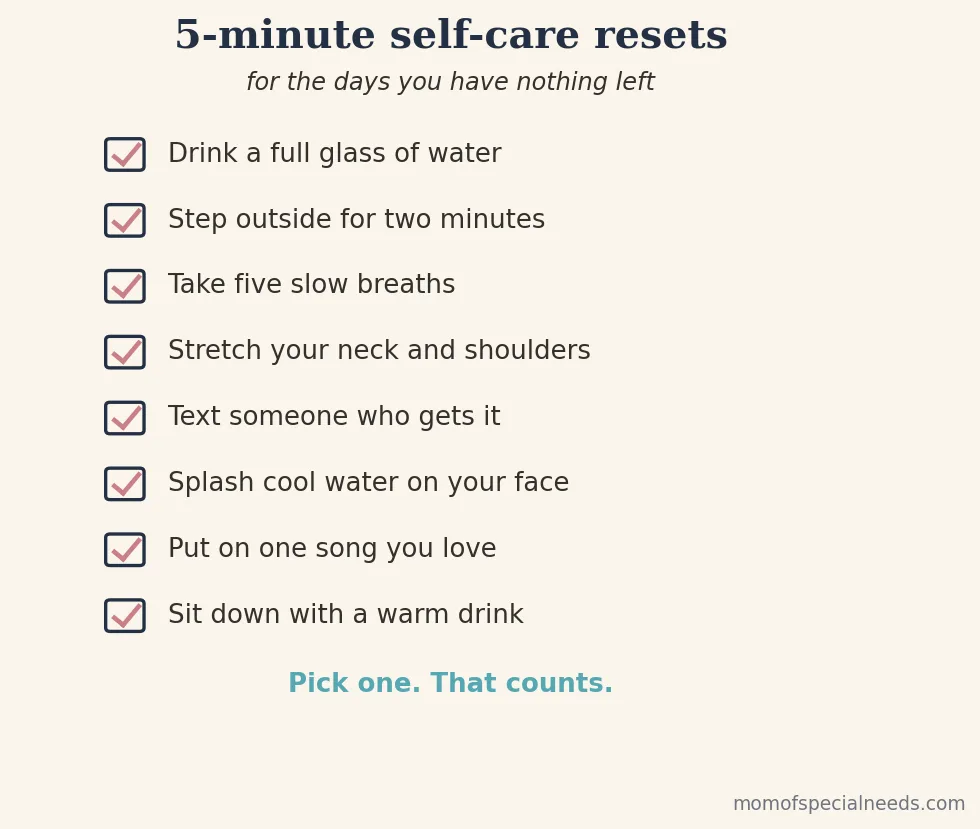
What does self-care actually look like for a special needs mom?
Self-care for a special needs mom means small repeatable nervous-system-regulating actions that can be done in 5 minutes or less, in any setting, without childcare. It is not bubble baths and yoga retreats. It is hydration, sunlight, one honest text, and 60 seconds of silence with the bathroom door locked.
This is not “self-care lite.” This is self-care that actually fits a high-demand caregiving life.
A 2022 study from UCSF found that half of moms of children with autism report symptoms consistent with clinical depression. Parents raising children with disabilities show consistently higher rates of stress, depression, and burnout than parents of typically developing children. The numbers are real. The cure cannot be a 90-minute morning routine. It has to be 5 minutes.
The 12 real 5-minute self-care things
1. Drink one full glass of water before you check your phone
Dehydration mimics anxiety. Even mild dehydration can lower your mood and make it harder to concentrate.
You probably wake up dehydrated. You probably check your phone before you drink anything. You probably feel anxious within 10 minutes of waking. These three things are connected.
One full glass of water. Before the phone. Every morning.
2. Step outside and look at the sky for 60 seconds
Cortisol drops measurably with morning light exposure. You do not need a walk. You need 60 seconds of looking up at the sky, ideally before 10 AM. Stand on your porch. Open a window. Sit on the back steps with coffee. Whatever fits.
3. The “one room” rule: tidy one surface, not the whole house
The whole house is overwhelming. One surface is doable. The kitchen counter. The bathroom sink. The coffee table. Five minutes. Then stop.
One tidy surface in a chaotic house feels like a win. The whole house feels like a punishment.
4. Put on real clothes for the next school pickup
Not athleisure. Not pajamas with a coat over them. Real clothes. Jeans and a shirt count.
This is not about looking good for other people. It is about reminding yourself that you are still a person who exists outside the caregiving role.
5. Eat one piece of fruit standing at the counter
You are probably skipping meals. You are probably eating the kids’ leftover chicken nuggets at 2 PM. One piece of fruit. One piece of cheese. One real food per day, deliberately.
The body needs more than coffee and adrenaline. Even if the brain is convinced otherwise.
6. Text one friend a voice memo, no obligation to listen back
Texting takes too much energy when you are depleted. Voice memos are easier. Send one to a friend who knows your life. Say “I just want to talk for 90 seconds, you do not need to respond.”
Most friends will love it. The ones who do not are not your friends right now.
7. The “no” rehearsal: practice saying no out loud once
Special needs moms get asked to volunteer, host, organize, attend, drop off, pick up, and emotionally regulate other people’s children at the rate of 6 times a week on average (rough estimate from my own informal counting, not a study).
You are saying yes to things you should be saying no to. The reason is that saying no out loud feels foreign.
Practice it. Out loud. In the car. “No, I cannot do that this month.” “No, that does not work for our family.” Just so the words are not strangers when you need them.
8. Wash your face with cold water in the middle of the day
Cold water on the face activates the vagus nerve. The vagus nerve is the parasympathetic system. The parasympathetic system is “rest and digest.” This is the same biological reset that the 60-Second Meltdown Reset uses for your child.
It works for you too.
9. Put on the song that used to make you cry in college
You had a self before you were a mom. She is still in there. She listened to a song that made her cry in the dorm room at 2 AM. Play that song. Cry if you need to. 4 minutes.
This is not regression. This is reunion.
10. Sit in the car for 3 extra minutes before going inside
The transition from car to house is brutal. Everything will need you the second you walk in. Sit. Three minutes. Eyes closed. Hands on the steering wheel.
This is the airlock. You are decompressing before reentry.
11. Write one sentence in the notes app: “Today was hard because…”
One sentence. Not a journal entry. Not a gratitude list. Not a manifestation.
One sentence. “Today was hard because she scratched me at the grocery store.” Naming the hard thing reduces its grip on you. The act of writing it is itself the regulation.
12. Lock the bathroom door and lean against it for 60 seconds
This is the bathroom-floor moment that founded this whole brand. Sometimes the only self-care that works is the back of a locked bathroom door for 60 seconds. The kids will live. The dog will live. The phone can wait. 60 seconds.
Why typical self-care advice does not work for special needs moms
Typical self-care assumes you have free time. You do not.
Typical self-care assumes you have energy at the end of the day. You do not.
Typical self-care assumes you have predictable childcare. You do not.
Typical self-care assumes you have the cognitive bandwidth to plan an elaborate evening routine. You do not.
The advice fails because the advice was written for someone whose life looks nothing like yours. You are not failing at self-care. You are being given the wrong instructions. Better instructions are the whole point of Finding Your Path, which builds a self-care plan around the life you actually have instead of the one the advice assumes.

Finding Your Path: A Guide to Self-Care for Mothers of Special Needs Children
What is the difference between self-care and avoidance?
Self-care is intentional nervous-system regulation that supports your ability to keep showing up. Avoidance is using activities to disconnect from feelings or responsibilities you need to face.
The honest test. Do you feel more present and capable after the activity? That is self-care. Do you feel more dissociated, numb, or behind on real things? That is avoidance.
Scrolling TikTok for 90 minutes is not self-care. Sitting in the car for 3 minutes is.
How do you start a self-care routine when you are already burnt out?
Start with one action. Not 12. Not 5. One.
Pick the easiest one on the list above. Probably the water glass. Do it tomorrow morning. Then the next morning.
Add the second action only after the first is automatic. This usually takes 2 to 3 weeks.
If you try to do all 12 starting Monday, you will fail by Wednesday and feel worse than before.
One thing. Build slow.
If burnout is already taking over your physical health, see the dedicated piece on caregiver burnout for special needs moms for the signs and the path back.
Frequently asked questions
What does self-care actually look like for a special needs mom?
Self-care for a special needs mom looks like small 5-minute nervous-system-regulating actions done consistently. Drinking water before checking the phone. Stepping outside for 60 seconds. Locking the bathroom door for 60 seconds. Eating one real food. The actions are not glamorous. They work because they fit the actual demands of caregiving life.
How do I do self-care when I have zero time?
Choose one 5-minute action and attach it to something you already do. Drink water while the coffee brews. Step outside while you wait for the bus to come. Lock the bathroom door while you brush your teeth. You do not need free time. You need attached time.
Why does typical self-care advice not work for special needs moms?
Typical self-care advice assumes free time, predictable childcare, energy at the end of the day, and the cognitive bandwidth to plan elaborate routines. Special needs moms have none of those things reliably. The advice fails because the assumptions are wrong, not because you are bad at self-care.
What is the difference between self-care and avoidance?
Self-care leaves you more present and capable. Avoidance leaves you more dissociated and behind. Scrolling for 90 minutes is avoidance. A 60-second pause in the car is self-care. The honest test is how you feel after, not how it looked from outside.
How do I start a self-care routine when I am already burnt out?
Start with one action only. Pick the easiest one on the list. Do it for 2 to 3 weeks until it is automatic. Then add a second action. Trying to start all 12 at once will fail by Wednesday. Build slow. The point is consistency, not intensity.
Can a 5-minute self-care routine really help?
Yes. Short, regular moments of self-regulation can ease stress over time, even when you cannot find a long stretch to yourself. The consistency matters more than the duration.
One last thing
If you only do one thing on this list, do the water glass tomorrow morning before the phone.
If you only do one other thing this month, lock the bathroom door for 60 seconds when you need to.
If today was really hard and the kids are finally asleep and you cannot remember which advice was supposed to help, the free 60-Second Meltdown Reset works for moms too. The 60 seconds are yours.
What does self-care actually look like for a special needs mom?
Self-care for a special needs mom looks like small 5-minute nervous-system-regulating actions done consistently. Drinking water before checking the phone. Stepping outside for 60 seconds. Locking the bathroom door for 60 seconds. Eating one real food. The actions are not glamorous. They work because they fit the actual demands of caregiving life.
How do I do self-care when I have zero time?
Choose one 5-minute action and attach it to something you already do. Drink water while the coffee brews. Step outside while you wait for the bus to come. Lock the bathroom door while you brush your teeth. You do not need free time. You need attached time.
Why does typical self-care advice not work for special needs moms?
Typical self-care advice assumes free time, predictable childcare, energy at the end of the day, and the cognitive bandwidth to plan elaborate routines. Special needs moms have none of those things reliably. The advice fails because the assumptions are wrong, not because you are bad at self-care.
What is the difference between self-care and avoidance?
Self-care leaves you more present and capable. Avoidance leaves you more dissociated and behind. Scrolling for 90 minutes is avoidance. A 60-second pause in the car is self-care. The honest test is how you feel after, not how it looked from outside.
How do I start a self-care routine when I am already burnt out?
Start with one action only. Pick the easiest one on the list. Do it for 2 to 3 weeks until it is automatic. Then add a second action. Trying to start all 12 at once will fail by Wednesday. Build slow. The point is consistency, not intensity.
Can a 5-minute self-care routine really help?
Yes. Short, regular moments of self-regulation can ease stress over time, even when you cannot find a long stretch to yourself. The consistency matters more than the duration.