Quick stats first
- Approximately 42% of autistic individuals engage in some form of self-injurious behavior, according to a 2020 meta-analysis of 37 studies covering 14,379 participants (source: Journal of Autism and Developmental Disorders, 2020). Hand-hitting is the most common form, seen in about 23 percent of cases.
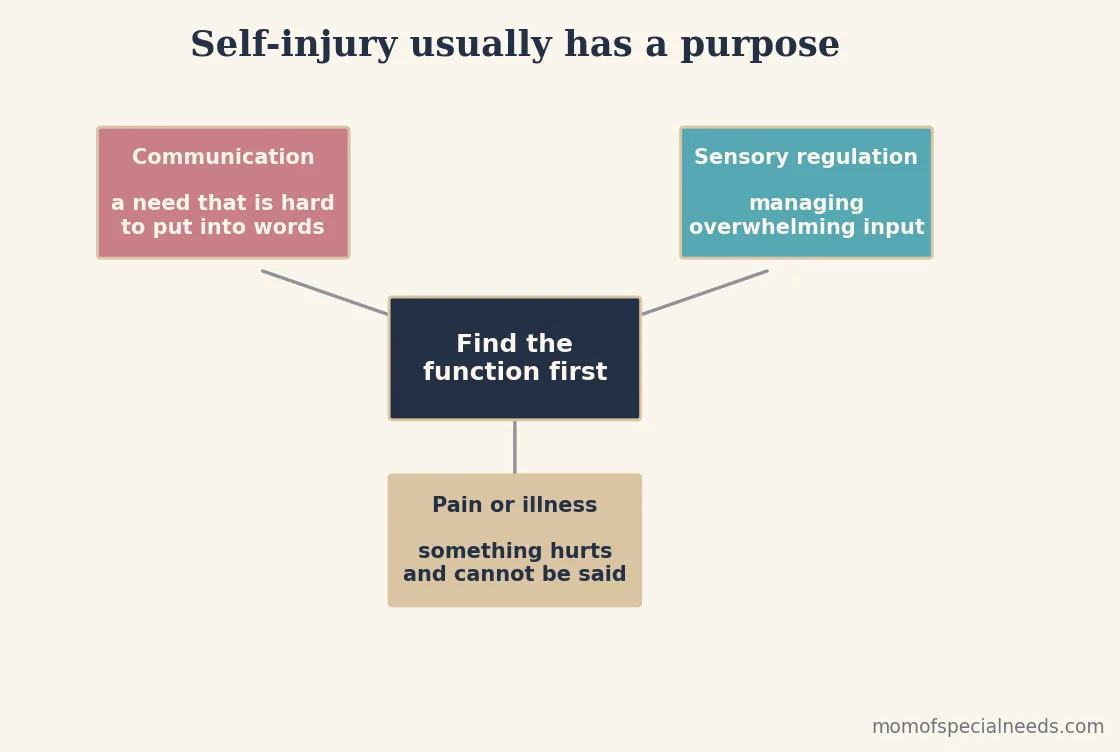
- Self-injury usually serves a purpose. It can be a way to communicate a need that is hard to put into words, to manage overwhelming sensory input, or to respond to pain. The function is the key to the response (Minshawi NF, et al. 2014, describing self-injury as serving social-communicative or self-stimulatory functions).
Is my autistic child’s self-injury manipulation or is something else happening?
Self-injurious behavior in autism is almost never manipulation. In the vast majority of cases, it is your child’s nervous system or communication system doing the only thing it knows how to do right now. This is the first thing I want you to hold onto, because the fear that your child is “doing it on purpose to get a reaction” is one of the most painful thoughts a parent can sit with. And it is almost certainly not true. Here is what is usually true instead. Your child’s brain processes the world differently. Sensory input that feels neutral to you can feel overwhelming or even physically painful to them. Emotions that they cannot name or regulate can build up like pressure with no release valve. Words that you need them to use may simply not be available to them in that moment, even if they are verbal at other times. SIB in those situations is not strategic. It is what happens when a nervous system has run out of other options. A Board Certified Behavior Analyst (BCBA) would explain this using the four functions of behavior: sensory stimulation, escape or avoidance, access to attention, and access to tangibles. Most SIB in autism falls primarily under sensory stimulation or escape. The behavior is doing something for your child. It is not being done to you. That reframe will not make watching it easier. But it matters enormously for how you respond, because the response that works for manipulation is the exact opposite of the response that works for overwhelm. autism meltdownsWhy does my autistic child hit their head or bite themselves during a meltdown?
During a meltdown, self-injurious behavior spikes because the nervous system is flooded and your child has lost access to any regulated state. The SIB is often the last available exit valve. Think about what is happening in your child’s body during a meltdown. Their stress hormone levels are spiking. Their sensory filters have collapsed. Their prefrontal cortex, which handles reasoning and language, is essentially offline. They are in a state of full neurological overwhelm. In that moment, head banging can actually create a kind of counter-pressure that interrupts the sensory flood. Biting provides intense proprioceptive input that can briefly ground a dysregulated nervous system. Scratching or hitting can release the physical tension of bottled-up emotion the same way an adult might slam a door or cry hard. None of this is a choice. It is physiology. I watched my son bite his arm until he left marks during a meltdown at a birthday party when he was five. My first instinct was to grab his arm and pull it away. That made everything ten times worse because I had just added a physical struggle on top of everything he was already processing. The second time it happened, I sat on the floor next to him, kept my hands still, and just said his name quietly. It took eleven minutes. Eleven minutes is forever when you are watching your child hurt themselves. But the meltdown passed without escalation, and afterward he climbed into my lap. During a meltdown, SIB is a symptom of the meltdown. The meltdown is the problem to address. what happens in the brain during a meltdownWhat are the most common reasons an autistic child hurts themselves outside of meltdowns?
Outside of meltdowns, SIB usually falls into three categories: sensory seeking, pain communication, or learned communication. Sensory seeking. Some children bang their heads or bite themselves because the input feels regulating. The rhythm of head banging against a firm surface provides proprioceptive input that can calm an under-stimulated or over-stimulated nervous system. This is especially common at transitions, during quiet unstructured time, or before sleep. It looks alarming. The function is genuinely self-soothing. Ready for Anything has the incident log and the crisis call list already built, so you are not designing them mid-episode. Pain communication. This one is critically underrecognized. A non-speaking or minimally verbal autistic child who suddenly develops or increases SIB may be in physical pain with no other way to tell you. Ear infections, gastrointestinal issues, dental pain, and headaches are the most common culprits. If your child’s SIB increased suddenly and you cannot identify a behavioral trigger, rule out a medical cause first. Talk to your pediatrician before assuming it is behavioral. Learned communication. Over time, some children learn that SIB reliably produces a response, and that response is something they want, whether that is your attention, an escape from a demand, or access to something they need. This is not manipulation in the calculating sense. It is your child finding the one tool that works. The fix is not punishment. It is giving them a more efficient tool. functional communication training for self-injuryWhen should I be worried about my autistic child’s self-injurious behavior?
Some SIB is within the common range for autism and responds to behavioral support. Other SIB needs medical or psychiatric attention urgently. Treat it as a same-day call to your pediatrician or ER if:- The injury is severe, meaning bleeding that does not stop, signs of concussion such as vomiting or loss of consciousness after head banging, or broken skin that is deep.
- SIB escalated suddenly with no behavioral explanation, especially if your child seems to be indicating a specific body part.
- Your child’s SIB is new and appeared within days of a medication change.
- You cannot keep your child or other family members physically safe.
- SIB is happening daily or multiple times per week.
- SIB is increasing in frequency or intensity over weeks.
- Current strategies have stopped working or never worked.
- Your child is leaving marks, bruises, or calluses on their skin from the behavior.
- Occasional head banging tied to clear triggers such as transitions or demand situations.
- Mild hand biting or scratching during sensory overload that de-escalates within minutes.
- SIB that is decreasing or stable over time with current supports.
What can I do tonight when my child is hurting themselves?
Your job in the moment is to reduce harm and reduce escalation, in that order. You cannot teach, reason, or redirect during active SIB. Step 1: Lower sensory input immediately. Dim lights if you can. Reduce noise. Move to a calmer space if your child will tolerate it. Do not add your own loud or urgent voice to the environment. Step 2: Get to their level without grabbing. Sit on the floor near them, not over them. A towering adult body in that moment adds threat signals to an already flooded nervous system. Step 3: Offer a physical buffer, not a physical restraint. If they are head banging on a hard floor or wall, place a cushion or your hand between their head and the surface. Do this gently and without struggle. If they resist, step back and protect the environment instead of their body. Move furniture. Cover sharp corners. Step 4: Use the fewest words possible. One word or phrase, repeated calmly. Their name. “I’m here.” “Safe.” Not questions, not explanations, not consequences. Step 5: Wait and witness. A meltdown has a neurological arc. It will peak and come down. Your job is to keep them physically safe through that arc without adding fuel. After the SIB episode, write down what happened before it started. Time of day. What they had eaten. What activity they were doing or being asked to do. What had changed in the environment. That log is the beginning of your data. A BCBA needs that data. If this is helping you make sense of a behavior that has been terrifying you, the longer framework with 27 specific daily tactics is inside Boundless Love.How do I document self-injurious behavior for a BCBA or behavioral therapist?
Document the ABC: Antecedent, Behavior, Consequence. Do this for every SIB episode for at least two weeks before your first BCBA appointment. Antecedent means what was happening in the 10 to 15 minutes before the behavior started. Be specific. Not “he was upset.” More like: “We were transitioning from iPad to dinner. He was told to stop three times. The TV was on in the background.” Behavior means a physical description, not an interpretation. Not “he had a meltdown.” More like: “He banged his right fist on the top of his head approximately 12 times over 4 minutes. He then bit his left forearm, leaving a mark that faded within 20 minutes.” Consequence means what happened immediately after. Not what you intended to do. What actually happened. “I removed the iPad, gave him a snack, and sat with him.” or “I redirected him to his room and the behavior continued for another 8 minutes.” Log the duration, the intensity on a simple scale of 1 to 3, and the time of day. Do this on paper, in a notes app, or in a spreadsheet. When you walk into a BCBA’s office with two weeks of ABC data, you cut months off the assessment timeline. A BCBA conducts a Functional Behavior Assessment (FBA) to identify the function of the SIB. Once the function is identified, the intervention is built around replacing the SIB with a behavior that serves the same function but is safer. That process is called Functional Communication Training (FCT) and it has a strong evidence base for reducing SIB in autism.Who should I call first: a BCBA, a psychiatrist, or a neurologist?
The right provider depends on what your gut is telling you about why the SIB is happening. Call a BCBA first if: The SIB is clearly tied to behavioral triggers, transitions, demands, or sensory situations. This is a behavioral problem with a behavioral solution. Call a psychiatrist first if: Your child has a co-occurring diagnosis such as anxiety, OCD, or a mood disorder, and the SIB seems connected to those states. Some SIB in autism is driven by obsessive-compulsive patterns or severe anxiety and needs medication support alongside behavioral work. Call a neurologist first if: The SIB is sudden, severe, and accompanied by any neurological signs. Seizure activity can manifest as SIB in some autistic children. A neurological rule-out is appropriate when onset is abrupt and medically unexplained. In most situations, you will eventually need more than one of these providers. Start with whoever your gut says fits the clearest picture of what you are seeing. Then build the team. caregiver mental health support for special needs parents
Have the plan before the next one
Ready for Anything: 20 Systems to Prepare for Medical and Healthcare Crises Before They Happen
Self-injury episodes are not the time to work out who to call. Ready for Anything gives you 20 crisis systems, including the incident log, the one page child profile, the emergency contact sheet and what to take to the hospital.
Get Ready for Anything $29.99Sources and further reading
- functional communication training for self-injury
- caregiver mental health support for special needs parents
Frequently asked questions
Is head banging in autism dangerous?
Autism self-injurious behavior head banging can range from mild and self-soothing to severe and medically concerning. Mild, infrequent head banging against soft surfaces typically does not cause injury. Repeated, forceful head banging against hard surfaces over time can cause tissue damage, skin breakdown, or in rare cases concussive injury, and warrants immediate clinical attention and a protective helmet evaluation.Why does my autistic child bite themselves?
Self-biting in autism is usually serving one of three functions: sensory input, communication of distress, or escape from a demand. The biting provides proprioceptive feedback that can regulate the nervous system, or it reliably produces a response from caregivers that the child needs. A BCBA can identify the specific function through a Functional Behavior Assessment.Will my autistic child grow out of self-injurious behavior?
Some children do reduce or stop SIB as they develop better communication and self-regulation skills, especially with early intervention support. However, SIB that is untreated and reinforced over time often increases rather than decreases. Early behavioral intervention with a qualified BCBA gives your child the best chance of learning safer replacement behaviors.Is self-injurious behavior the same as self-harm in teenagers?
They share surface similarities but have meaningfully different origins in most cases. SIB in young autistic children is typically sensory or communicative in function. Self-harm in adolescents is more often related to emotional pain regulation and usually carries different psychological underpinnings. As autistic children reach adolescence, the picture can become more complex and a psychiatrist familiar with autism should be involved.Should I hold my child to stop them from hurting themselves?
Physical restraint should only be used as a last resort to prevent serious injury, and only by trained professionals or caregivers who have been trained in safe holds. Untrained restraint frequently escalates SIB, creates additional trauma, and can result in injury to the child or caregiver. A BCBA can train you in safe physical management strategies if they are clinically appropriate for your child.What is a replacement behavior and how does it help with SIB?
A replacement behavior is a safer action that serves the same function as the SIB. For example, if head banging is serving a sensory input function, a replacement behavior might be pressing a vibrating sensory tool against the forehead or wearing a weighted cap. The key is that the replacement must meet the same need just as quickly and efficiently as the SIB did, or your child will return to the SIB.Do autistic girls show SIB differently than autistic boys?
Research on sex differences in SIB presentation in autism is still limited, but clinicians increasingly note that autistic girls are more likely to mask behavioral signs in public and may show SIB more in private or domestic settings. SIB in autistic girls is also sometimes misinterpreted as anxiety or mood disorder symptoms rather than autism-related behavior, which delays accurate assessment.Can a change in routine cause SIB to spike?
Yes, and this is one of the most common patterns. Routine disruptions, school transitions, family changes, and even seasonal schedule shifts can significantly increase the frequency and intensity of SIB in autistic children. The behavior is often communicating “this change is too much for my nervous system right now.” Pre-transition support, visual schedules, and advance preparation can reduce these spikes.What to remember
Your child hitting themselves is not evidence that you have failed them. It is evidence that they are overwhelmed and working with a nervous system that processes the world very differently than yours does. The behavior has a function, the function can be identified, and there are evidence-based approaches that help. You do not have to figure this out alone, and you do not have to white-knuckle through the scary parts with nothing but your instincts. If you want more of this kind of honest, practical support, the MoSN newsletter sends one email a week, no fluff. SubscribeNext step
Ready for Anything: 20 Systems to Prepare for Medical and Healthcare Crises Before They Happen
Tonight you get through it. Before the next one you can be ready for it. Ready for Anything is 20 systems already written.
Get Ready for Anything $29.99